<?xml version="1.0" encoding="utf-8"?>
<feed xmlns="http://www.w3.org/2005/Atom">
    <title>UK FOIA requests - Spy Blog</title>
    <link rel="alternate" type="text/html" href="http://p10.hostingprod.com/@spyblog.org.uk/blog/foia/" />
    <link rel="self" type="application/atom+xml" href="http://p10.hostingprod.com/@spyblog.org.uk/blog/foia/atom.xml" />
   <id>tag:p10.hostingprod.com,2007:/@spyblog.org.uk/blog/foia//2</id>
    <link rel="service.post" type="application/atom+xml" href="http://p10.hostingprod.com/@spyblog.org.uk/blog-mt/mt-atom.cgi/weblog/blog_id=2" title="UK FOIA requests - Spy Blog" />
    <updated>2007-10-05T11:42:26Z</updated>
    
    <generator uri="http://www.sixapart.com/movabletype/">Movable Type 3.2ysb5-20051201</generator>
 
<entry>
    <title>Over 1000 days since the FOIA request for the early OGC Gateway Reviews of the Home Office&apos;s Identity Cards Programme</title>
    <link rel="alternate" type="text/html" href="http://p10.hostingprod.com/@spyblog.org.uk/blog/foia/2007/09/over_1000_days_since_the_foia_request_for_the_early_ogc_gateway_reviews_of_the.html" />
    <link rel="service.edit" type="application/atom+xml" href="http://p10.hostingprod.com/@spyblog.org.uk/blog-mt/mt-atom.cgi/weblog/blog_id=2/entry_id=2777" title="Over 1000 days since the FOIA request for the early OGC Gateway Reviews of the Home Office's Identity Cards Programme" />
    <id>tag:p10.hostingprod.com,2007:/@spyblog.org.uk/blog/foia//2.2777</id>
    
    <published>2007-09-29T19:31:47Z</published>
    <updated>2007-10-05T11:42:26Z</updated>
    
    <summary>The Information Commissioner may have been publicising Friday 28th September as international Your Right To Know Day (.pdf), but another Anniverseray has now been reached: It is now over 1000 days since our original Freedom of Information Act request was...</summary>
    <author>
        <name>wtwu</name>
        
    </author>
            <category term="OGC Gateway Reviews of the Identity Cards Programme" />
    
    <content type="html" xml:lang="en" xml:base="http://p10.hostingprod.com/@spyblog.org.uk/blog/foia/">
        <![CDATA[<p>The Information Commissioner may have been publicising Friday 28th September as  <a href="http://www.ico.gov.uk/upload/documents/pressreleases/2007/international_right_to_know_day_260907_final.pdf" target="iyrtkd" title="opens ina new window .PDF">international Your Right To Know Day</a> (.pdf), but another Anniverseray has now been reached:</p>

<p><strong>It is now over 1000 days</strong> since our original Freedom of Information Act request was submitted, initially to both  the Office of Government Commerce and to the Home Office, for the to pre-Stage Zero and the actual Stage Zero Gateway review reports, on the Home Office's Identity Cards Programme.</p>

<p>Despite years of delays, and an appeal to the Information Commissioner, who made a Decision in favour of full publication, back in July 2006, folllowed by an appeal by the OGC to the Information Tribunal, who also found in favour of full disclosure in May 2007. The OGC is currently wasting more public money by appealing to the High Court.</p>

<p>These Gateway Review reports have still not been disclosed.</p>

<p>The High Court resumes its non-emergency activities after the summer break on Monday.</p>

<p>We will be nagging them to disclose  when the alleged OGC  appeal, supposedly on  a point of law, rather than just the balance of the interpretation of the law, against the Information Tribunal's ruling is to be heard.  </p>

<p>See <a href="http://p10.hostingprod.com/@spyblog.org.uk/blog/foia/ogc_gateway_reviews_of_the_identity_cards_programme/" target="ogcgra" title="opens in a new window">OGC Gateway Reviews of the Identity Cards Programme category archive</a> for the history of this deliberate and disgraceful bureaucratic and political suppression of our rights under the Freedom of Information Act 2000.</p>

<p>It is very likely that when, not if,  the High Court finds in our favour, and orders the Labour government to disclose the by now, very out of date documents, we will want to know exacly how much this has cost the taxpayer in terms of legal fees and civil servants' time.</p>

<p><strong><u>UPDATE: 5th October 2007</u></strong></p>

<p>The OGC have emailed to say that the High Court date for their appeal against the decision of the Information Tribunal regarding their ordering of the full publication of the Home Office Identity Cards Programme early Gateway Review reports, has provisionally been set for <strong>Tuesday 4th and Wednesday 5th March 2008</strong> at the Royal Courts of Justice (times and Court still to be decided nearer the date).</p>

<p>Even assuming that the High Court makes a Judgement (hopefully rejecting the appeal of the OGC))  on the Wednesday, this will be at least <strong>3 years 2 months 3 days i.e.1158 days</strong>  since the original FOIA request to the Office of Government Commerce and the Home Office, when the Freedom of Information Act 2000 came fully into force on 1st January 2005.</p>

<p> <br />
</p>]]>
        
    </content>
</entry>
<entry>
    <title>Foreign &amp; Commonwealth Office refuses to disclose just the Names and Job Titles of the diplomats expelled over the Polonium-210 murder affair</title>
    <link rel="alternate" type="text/html" href="http://p10.hostingprod.com/@spyblog.org.uk/blog/foia/2007/08/foreign_commonwealth_office_refuses_to_disclose_just_the_names_and_job_titles_of.html" />
    <link rel="service.edit" type="application/atom+xml" href="http://p10.hostingprod.com/@spyblog.org.uk/blog-mt/mt-atom.cgi/weblog/blog_id=2/entry_id=2654" title="Foreign &amp; Commonwealth Office refuses to disclose just the Names and Job Titles of the diplomats expelled over the Polonium-210 murder affair" />
    <id>tag:p10.hostingprod.com,2007:/@spyblog.org.uk/blog/foia//2.2654</id>
    
    <published>2007-08-23T14:50:17Z</published>
    <updated>2007-08-23T15:08:05Z</updated>
    
    <summary>Incredibly, the Foreign &amp; Commonwealth Office have refused to disclose: &quot; the names and job titles of : a) the Russian Federation Embassy or Consular staff in London or elsewhere in the United Kingdom, and b) the United Kingdom Embassy...</summary>
    <author>
        <name>wtwu</name>
        
    </author>
            <category term="FCO diplomatic expulsions Polonium 210 murder affair" />
    
    <content type="html" xml:lang="en" xml:base="http://p10.hostingprod.com/@spyblog.org.uk/blog/foia/">
        <![CDATA[<p>Incredibly, the Foreign & Commonwealth Office have <strong>refused to disclose</strong>:</p>

<blockquote>" the names and job titles of :

<p>a) the Russian Federation Embassy or Consular staff in London or <br />
elsewhere in the United Kingdom,</p>

<p>and </p>

<p>b) the United Kingdom Embassy or Consular staff in Moscow or <br />
elsewhere in the Russian Federation,</p>

<p>who have been, or who are shortly being expelled, following the <br />
diplomatic incident over the failure to extradite or prosecute the <br />
suspect Andrei Lugovoi in the radioactive Polonium 210 murder case <br />
of British citizen Alexander Litvinenko."<br />
</blockquote></p>

<p>How, exactly are <strong>just</strong> the Names and the Job Tiles of British and Russian Diplomats to be considered as <strong>Personal Data</strong>  ? </p>

<p>Every Embassy in London and in Moscow and therefore every important foreign Government, already knows these Names and (former) Job Titles, and so do lots of foreign journalists. </p>

<p>Why can't the FCO publish them themselves ? </p>

<blockquote>
I can confirm that the FCO does hold this information.  However, we are withholding all the information you have requested under Section 40 (Personal Information) as the information is personal data relating to third parties, the disclosure of which would contravene one of the data protection principles. In such circumstances sections 40(2) and (3) of the Freedom of Information Act apply. In this case, our view is that disclosure would breach the first data protection principle. This states that personal data should be processed fairly and lawfully. It is the fairness aspect of this principle which, in our view, would be breached by disclosure. In such circumstances s.40 confers an absolute exemption on disclosure. There is, therefore, no public interest test to apply.</blockquote>
]]>
        <![CDATA[<blockquote>
Foreign and Commonwealth Office
RuSCCAD
W87
Main Building

<p>[name of FCO Civil Servant]<br />
DCO [telephone]<br />
[FCO email]</p>

<p><br />
20 August 2007</p>

<p><br />
FOI REQUEST nnnn/nn</p>

<p>I am writing to confirm that the FCO has now completed its search for information in relation to your request under the Freedom of Information Act, which the FCO received on 23 July 2007.  In that request you asked that we disclose the names and job titles of :</p>

<p>a) the Russian Federation Embassy or Consular staff in London or <br />
elsewhere in the United Kingdom,</p>

<p>and </p>

<p>b) the United Kingdom Embassy or Consular staff in Moscow or <br />
elsewhere in the Russian Federation,</p>

<p>who have been, or who are shortly being expelled, following the <br />
diplomatic incident over the failure to extradite or prosecute the <br />
suspect Andrei Lugovoi in the radioactive Polonium 210 murder case <br />
of British citizen Alexander Litvinenko.</p>

<p>I can confirm that the FCO does hold this information.  However, we are withholding all the information you have requested under Section 40 (Personal Information) as the information is personal data relating to third parties, the disclosure of which would contravene one of the data protection principles. In such circumstances sections 40(2) and (3) of the Freedom of Information Act apply. In this case, our view is that disclosure would breach the first data protection principle. This states that personal data should be processed fairly and lawfully. It is the fairness aspect of this principle which, in our view, would be breached by disclosure. In such circumstances s.40 confers an absolute exemption on disclosure. There is, therefore, no public interest test to apply.</p>

<p><br />
If you have any queries about this letter, please contact me. Please remember to quote the reference number above in any future communications. </p>

<p>If you are unhappy with the service you have received in relation to your request and wish to make a complaint, or request a review of our decision you should write to me at the above address. You have 40 working days to do so. </p>

<p>If you are not content with the outcome of that internal review, you may apply directly to the Information Commissioner for a decision. Generally, the ICO cannot make a decision unless you have exhausted the complaint procedure provided by the Foreign and Commonwealth Office. The Information Commissioner can be contacted at: <br />
The Information Commissioner's Office <br />
Wycliffe House <br />
Water Lane <br />
Wilmslow <br />
Cheshire <br />
SK9 5AF </p>

<p><br />
Yours sincerely</p>

<p>[name of FCO Civil Servant]</p>

<p>Russia Section, RuSCCAD</p>

</blockquote>

<p>Somehow we feel Yet Another Complaint to the Information Commissioner is likely to be brewing, after the Internal Review.</p>]]>
    </content>
</entry>
<entry>
    <title>House of Commons - designation of Palace of Westminster and Portcullis House under SOCPA section 128 - redactions of faceless bureaucrats&apos;  names and contact details</title>
    <link rel="alternate" type="text/html" href="http://p10.hostingprod.com/@spyblog.org.uk/blog/foia/2007/08/house_of_commons_designation_of_palace_of_westminster_and_portcullis_house_under.html" />
    <link rel="service.edit" type="application/atom+xml" href="http://p10.hostingprod.com/@spyblog.org.uk/blog-mt/mt-atom.cgi/weblog/blog_id=2/entry_id=2640" title="House of Commons - designation of Palace of Westminster and Portcullis House under SOCPA section 128 - redactions of faceless bureaucrats'  names and contact details" />
    <id>tag:p10.hostingprod.com,2007:/@spyblog.org.uk/blog/foia//2.2640</id>
    
    <published>2007-08-20T15:57:11Z</published>
    <updated>2007-08-23T21:53:26Z</updated>
    
    <summary>We have finally received a disclosure from the House of Commons authorities, regarding our Freedom of Information Act request about the the formerly public areas within the the Palace of Westminster and Portcullis House, which are now within the boundary...</summary>
    <author>
        <name>wtwu</name>
        
    </author>
            <category term="House of Commons" />
            <category term="SOCPA Section 128 Designated / Protected Sites" />
    
    <content type="html" xml:lang="en" xml:base="http://p10.hostingprod.com/@spyblog.org.uk/blog/foia/">
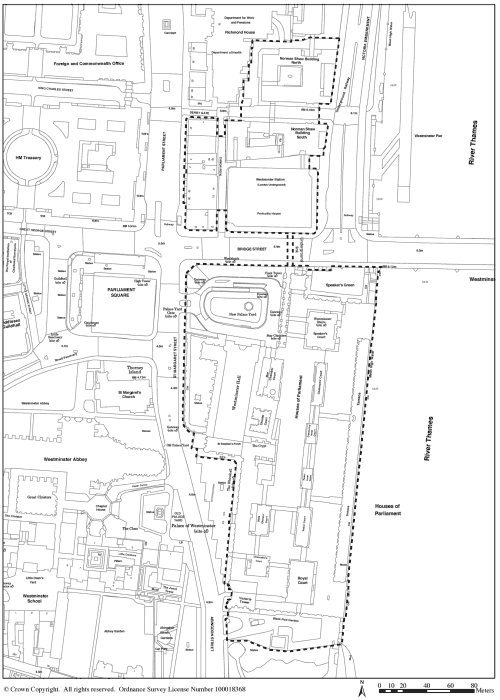
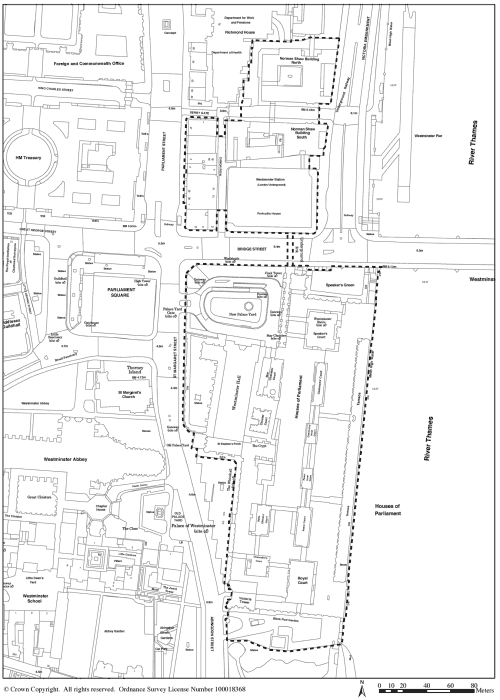
        <![CDATA[<p>We have finally received a disclosure from the House of Commons authorities, regarding our Freedom of Information Act request about the the <strong>formerly public</strong> areas within the the Palace of Westminster and Portcullis House, which are now within the boundary of a <strong>Protected Site</strong> under the <a href="http://www.opsi.gov.uk/ACTS/acts2005/50015--l.htm#128" target="_SOCPAs128" title="opens in a new window">Serious Organised Crime and Police Act 2005 Section 128 Offence of trespassing on designated site</a>, as amended by the <a href="http://http://www.opsi.gov.uk/acts/acts2006/60011--b.htm#12" target="_ta06s12" title="opens in a new window">Terrorism Act 2006 section 12.Trespassing etc. on nuclear sites</a>, as specified in the <a href="http://www.opsi.gov.uk/si/si2007/20070930.htm" target=_si" title="opens in a new window">Statutory Instrument 2007 No. 930 The Serious Organised Crime and Police Act 2005 (Designated Sites under Section 128) Order 2007</a>. specifically the map published in Schedule 8:</p>

<p><a href="http://p10.hostingprod.com/@spyblog.org.uk/blog/foia/images/07093008.gif" title="click for a larger image"><img alt="07093008.gif" src="http://p10.hostingprod.com/@spyblog.org.uk/blog/foia/images/07093008_300.gif" width="300" height="420" /></a></p>

<p>The paper hardcopy photopies reveal little of interest, except that it seems that the boundary around the main Palace of Westminster was originally going to extend some way into the River Thames, presumably along the as yet non-existent "security" boom or row of marker buoys.</p>

<p>How, exactly any Notices would have been fixed or how this law applies to the tidal River Thames is a mystery which is, at this point rather moot.</p>

<p>The memos and emails confirm that the Home Office was  desperate to ensure that there was adequate signage so as to prevent the statutory defence of ignorance of the boundary from being invoked.</p>

<p>There are a couple of <a href="http://www.dca.gov.uk/foi/guidance/exsumm/sec24.htm" target="_s24" title="opens in a new window">FOIA Section 24 National Security exemption </a> redactions, which one could perhaps argue about, since Section 128 of SOCPA has nothing to do with real security, and everything to do with the suppression of political dissent, and of minor non-violent, non-threatening publicity stunts.</p>

<p>What is really infuriating, however, is the policy of censorship or <strong>redaction</strong> of the Names, Job Titles, Email Addresses , Postal Addresses and DirectTelephone Numbers of some of the officials in these memos and emails, on what seems to be spurious grounds </p>

<p>In each case, the full text of the memos and emails was disclosed (apart from some small Section 24 National Security redactions) but, for the most part, the people who  were making the decisions and giving advice remain as faceless, nameless, contactless bureaucrats. <br />
</p>]]>
        <![CDATA[<p><br />
e.g.<br />
<a href="http://www.dca.gov.uk/foi/guidance/exsumm/sec36.htm" target="_s36" title="opens in a new window">FOIA Section 36 Prejudice to Effective Conduct of Public Affairs exemption</a> </p>

<p> <a href="http://www.dca.gov.uk/foi/guidance/exsumm/sec38.htm" target="_s38" title="opens in a new window">FOIA Section 38 Health and Safety exemption</a> </p>

<p><a href="http://www.dca.gov.uk/foi/guidance/exsumm/sec40.htm" target="_s40" title="opens in a new window">FOIA Section 40 Personal Data exemption</a> </p>

<p>The name and official job title of a public servant, or their contact details which they themselves publish on their letterheads, should <strong>not</strong> be considered as "Personal Data" to be redacted from FOIA requests. </p>

<p>This is in stark contrast to the <a href="http://p10.hostingprod.com/@spyblog.org.uk/blog/foia/2007/06/house_of_lords_discloses_a_couple_of_home_office_socpa_section_128_designated_protected_sites_documents.html" target="_hol" title="opens in a new window">disclosure from the House of Lords</a>, which saw no need to censor the contact details for Peter Mason, the Parliamentary Security Co-Ordinator<br />
or the same Home Officials in charge of this <strong>policy</strong> and the draughting of the Statutory Instrument secondary legislation.</p>

<blockquote>
[name]
[address]

<p>Ref: Ann-nnn</p>

<p>Tel: 020 7219 nnnn</p>

<p>Email: foicommons@parliament.uk</p>

<p>16 August 20007</p>

<p>Dear XXX</p>

<p><strong>Freedom of Information request Ann-nnn</strong></p>

<p>Thank you for your email in which you requested details of correspondence and minutes of meetings between the house of Commons and any other public authority, regarding the designation of the Palace of Westminster ans Portcullis House under Section 128 of the Serious Organised Crime and Police Act 2005. We are sorry that it has taken this length of time to deal with the matter.</p>

<p>Having searched our records, we enclose the information to which you are entitled under the Freedom of Information Act (the 'Act'). We hold the information in hard copy and it is not reasonably practical for the House to provide them in the format that you have requested. The documents have therefore been provided as photocopies of the hard-copies. To the extent that the other information may be held, exemptions apply - these are fully described below. We have indicated where information has been removed and cited the appropriate exemption.<br />
</blockquote></p>

<p>It is difficult to believe that the only copies of emails and and word processed documents sent in the last couple of years only exist as hardcopy printouts.</p>

<blockquote>
The House has concluded that some information covered by your request is subject to legal professional privilege and is exempt under section 42 of the Act. This is a non-absolute exemption and is subject to the public interest test. While there is a public interest that the decision making process of a public authority should be open to scrutiny, there is a countervailing public interest that an organisation should be able to seek legal advice without concern that it, or the fact that advice was sought, should be released into the public domain. After careful consideration, the house considers that in this instance the public interest in maintaining the confidentiality of legal advice outweighs the public interest in disclosure.

<p>References to the criteria for designation and details of security arrangements for Parliament and any government buildings are exempt from disclosure under section 24 of the Act, since , the exemption is required on order to safeguard national security, and is subject to the public interest test. While considering the public interest in the openness and transparency of public authorities, the security agencies have advised that the disclosure of this information would highlight security vulnerabilities and may expose certain sites to increased risk of attack. On the basis of this advice, the House considers that there is an over-riding public interest in maintaining the confidentiality of security arrangements for institutions which are critical to the effective governance of the united Kingdom. Therefore the public interest in maintaining the confidentiality of this information outweighs the public interest in disclosure.<br />
</blockquote></p>

<p>Our original request specifically did <strong>not</strong> for any of this sort of information.</p>

<blockquote>
The identities and addresses of some individuals and certain information about the Parliamentary Estate held by the House is covered by the exemption conferred by section 38 of the Act. This is a qualified exemption which relates to health and safety and the public interest test applies. While the decision making process of public authorities should be open to scrutiny, there is a countervailing public interest that the people involved should not be exposed to undue risk. Since the identities of critical security personnel and the precautions in place to mitigate security risks posed to staff may be of interest to any parties wanting to carry out a malicious act against the United Kingdom, disclosure of this information to the public may prejudice the health and safety of those individuals. Therefore the House considers that it is not in the public interest to disclose details of external security staff and security arrangements at the Houses of Parliament and the application of this exemption is upheld.
</blockquote>

<p>There is <strong>no justification</strong> to abuse this section 38 exemption to simply hide the Names, Job Titles , Email Addresses and Direct Telephone Numbers of Home Office officials in charge of <strong>policy</strong>, which is what has been redacted in this disclosure. Illogically, the physical address and flior number and name of the department for which they work at the Home Office has <strong>not</strong> been redacted, so the only "risk" appears to be via email or via landline office telephone. Any such "risk" is exactly the same as for the other tens of thousands of users of the *.gsi.gov.uk Government Secure Intranet email gateways.</p>

<p>All of this information is freely published in the standard Letterhead which these Home Office Civil Servants use, so they obviously do not feel threatened by its publication and dissemination.</p>

<p>Surely this cannot possibly meet the "more than 50% likely to cause harm" proportionality test which should have been applied in the public interest test applied to this claimed Section 38 exemption ?<br />
 <br />
<blockquote><br />
Names of non-Parliamentary staff contained in the provided documets relate to living, identifiable information, the disclosure of which is governed by the provisions of the Data Protection Act 1998. This information is personal to the individuals concerned and its disclosure wpi;d not be consistent with data protection principles. Therefore, these details have been removed as they are exempt from disclosure under section 40 of the Act (personal data). This is an absolute exemption and the public interest test does not apply.<br />
</blockquote></p>

<p>Where this exemption has been applied, appears to be simply to censor the Names of people on email distribution lists or of invited participants to meetings. There are no "personal data" , perhaps just a name and an official job title.</p>

<p>This does <strong>not</strong> constitute "personal data" as defined in the Information Commissioner's Office Guidance Note number 1:</p>

<p>The Information Commissioner's Office <a href="<br />
http://www.ico.gov.uk/upload/documents/library/freedom_of_information/detailed_specialist_guides/awareness_guidance%20_1_%20personal_information_v2.pdf" target="_icogn1" title="opens in a new window">FOIA Guidance Note 1</a> (.pdf) says:</p>

<ul><li>
"In thinking about fairness, it is likely to be helpful to ask whether the information relates to the private or public lives of the third party. Information which is about the home or family life of an individual, his or her personal finances, or consists of personal references, is likely to deserve protection. <strong>By contrast, information which is about someone acting in an official or work capacity should normally be provided on request</strong> unless there is some risk to the individual concerned"</ul>

<blockquote>
Other information held by the house and relevant to your request may be exempt from disclosure under section 36 of the Act. This is on the grounds that, in my view, the Speaker, who is the qualified person for the purposes of that section, is likely to be of the opinion that disclosure would, or would be likely to, inhibit the free and frank exchange of views and advice. For the same reason, certain telephone numbers and email addresses have also been removed from the provided documents since disclosure would, or would be likely to, prejudice the effective conduct of public affairs. This is an absolute exemption and the public interest test does not apply.
</blockquote> 

<p>This is nonsense. The redactions to which this section 36 has been used as the excuse, are of the postal addresses and email addresses and direct telephone numbers of the Home Office officials and of Peter Mason, the Parliamentary Security Co-Ordinator.</p>

<p>The <strong>contents</strong> of the emails and letters disclosed has  <strong>not</strong> been redacted under section 36. </p>

<p>How can the contents not "prejudice the effective conduct of public affairs", but the names and contact details which are in the Letterhead section of these documents somehow does so ? <br />
 <br />
<blockquote><br />
You may, if dissatisfied with the treatment of your request, ask the House of Commons to conduct am internal review of the decision. The internal review will be conducted by someone other than the person who took the initial decision. Request for internal reviewshould be addressed to the Freedom of Information Officer, Department of Fuinance and Administration, 7 Millbank, London, SW1P 3JA or foicommons@parliament.co.uk. Please ensure that you specify the nature of your complaint and any arguments or points that tou wish to make in support of your position. If the decision to apply section 36 is upheld by the review, then the Speaker will be invited to issue a certificate under section 36(7). The certificate will provide conclusive evidence that the exemption is required for the above stated purpose.</p>

<p>If following the internal review you remain dissatisfied with the House's treatment of your request then you may take your complaint to the Information Commissioner at: Wycliffe House, Water Lane, Wilmslow, Cheshire, SK9 5AF</p>

<p>Yours sincerely</p>

<p>Bob Castle<br />
Data Protection and Freedom of Information Officer<br />
</blockquote></p>

<p>N.B. both the postal address of the Office of the Parliamentary Security Co-ordinator and the names , email addresses, and direct telephone numbers of the two Home Office civil servants, as per their standard Letterheads,   have been previously disclosed through our FOIA request to the House of Lords on the identical topic.</p>

<p>In several redactions, these details are censored in the disclosure by the House Commons both under Section 36 Prejudicial to the Conduct of Public Affairs and, at the same time also under Section 38 Health and Safety.</p>]]>
    </content>
</entry>
<entry>
    <title>Foreign &amp; Commonwealth Office: names &amp; job titles of the Russian and UK diplomats expelled after the Polonium 210 murder affair</title>
    <link rel="alternate" type="text/html" href="http://p10.hostingprod.com/@spyblog.org.uk/blog/foia/2007/07/foreign_commonwealth_office_names_job_titlesof_the_russian_and_uk_diplomats_expe.html" />
    <link rel="service.edit" type="application/atom+xml" href="http://p10.hostingprod.com/@spyblog.org.uk/blog-mt/mt-atom.cgi/weblog/blog_id=2/entry_id=2514" title="Foreign &amp; Commonwealth Office: names &amp; job titles of the Russian and UK diplomats expelled after the Polonium 210 murder affair" />
    <id>tag:p10.hostingprod.com,2007:/@spyblog.org.uk/blog/foia//2.2514</id>
    
    <published>2007-07-22T12:58:17Z</published>
    <updated>2007-07-22T13:13:28Z</updated>
    
    <summary>The Foreign &amp; Commonwealth Office website does not seem to provide details of any easy methods for the public to contact the FCO on anything except travel related matters. There is a General telephone number,but no email, or postal address...</summary>
    <author>
        <name>wtwu</name>
        
    </author>
            <category term="FCO diplomatic expulsions Polonium 210 murder affair" />
    
    <content type="html" xml:lang="en" xml:base="http://p10.hostingprod.com/@spyblog.org.uk/blog/foia/">
        <![CDATA[<p>The <a href="http://www.fco.gov.uk" target="_fco" title="opens in a new window">Foreign & Commonwealth Office</a> website does not seem to provide details of any easy methods for the public to contact the FCO on anything except travel related matters.</p>

<p>There is a General telephone number,but no email, or postal address etc. or any email or postal mail contact details for the Foreign Office Ministers etc. They even seem to keep their Press Office details secret from the general public.</p>

<p>Hence we have reluctantly had to resort to a Freedom of Information Act request to try to elicit the names and job titles of the Russian and United Kingdom diplomats etc. who have been or who are in the process of being expelled as <em>persona non grata</em>,  following the diplomatic incident over the failure to extradite or prosecute the suspect Andrei Lugovoi, in the radioactive Polonium 210 murder case of British citizen Alexander Litvinenko.</p>

<p>Every foreign government and intelligence agency will know who these people are, through their own normal diplomatic representatives in London and Moscow, so why shouldn't the UK general public know as well ?<br />
</p>]]>
        <![CDATA[<blockquote>
Information Rights Team<br>
Information Management Group<br>
Foreign and Commonwealth Office<br>
Old Admiralty Building<br>
London<br>
SW1A 2PA

<p>E-mail: dp-foi.img@fco.gov.uk </p>

<p>Sunday 22nd July 2007</p>

<p>Dear Sirs,</p>

<p>Under the Freedom of Information Act 2000:</p>

<p>Please disclose the names and job titles of </p>

<p>a) the Russian Federation Embassy or Consular staff in London or elsewhere in the United Kingdom,</p>

<p>and </p>

<p>b) the United Kingdom Embassy or Consular staff in Moscow or elsewhere in the Russian Federation,</p>

<p>who have been, or who are shortly being expelled, following the diplomatic incident over the failure to extradite or prosecute the suspect Andrei Lugovoi in the radioactive Polonium 210 murder case of British citizen Alexander Litvinenko.</p>

<p>Please provide the information, ideally by publishing it on your public world wide website, or alternatively by email.</p>

<p>Ideally this should *not* be in the form of a "copy and paste" locked Adobe .pdf file, or similar, attachment.</p>

<p>In the unlikely event that this information is not already available in a standard electronic format, then please explain the reasons why, when you provide the information in another format.</p>

<p>If you are proposing to make a charge for providing the information requested, please provide full details in advance, together with an explanation of any proposed charge.</p>

<p>If you decide to withhold any of the information requested, you should clearly explain why you have done so in your response, by reference to the Freedom of Information Act 2000 legislation.</p>

<p>If your decision to withhold is based upon an evaluation of the Public Interest, then you should clearly explain which public interests you have considered, and why you have decided that the public interest in maintaining the exception(s) outweighs the public interest in releasing the information.</p>

<p>I look forward to receiving the information requested as soon as possible, and in any event, within the statutory 20 working days from receipt of this email i.e. by Tuesday 21st August 2007</p>

<p>Yours Sincerely,</p>

<p>[name]<br />
[address]<br />
[email]<br />
</blockquote><br />
</p>]]>
    </content>
</entry>
<entry>
    <title>Home Office EIR request - internal review and disclosure re Westminster Tracer Gas Trials</title>
    <link rel="alternate" type="text/html" href="http://p10.hostingprod.com/@spyblog.org.uk/blog/foia/2007/07/home_office_eir_request_internal_review_and_disclosure_re_westminster_tracer_gas.html" />
    <link rel="service.edit" type="application/atom+xml" href="http://p10.hostingprod.com/@spyblog.org.uk/blog-mt/mt-atom.cgi/weblog/blog_id=2/entry_id=2505" title="Home Office EIR request - internal review and disclosure re Westminster Tracer Gas Trials" />
    <id>tag:p10.hostingprod.com,2007:/@spyblog.org.uk/blog/foia//2.2505</id>
    
    <published>2007-07-18T21:41:06Z</published>
    <updated>2007-07-21T09:37:55Z</updated>
    
    <summary>The Home Office has conducted its Internal Review into our Environmental Information Regulations 2004 request, about the Westminster Tracer Gas Trials, which they tried to fob off onto DEFRA. Essentially, they have disclosed the information which was asked for,i.e. details...</summary>
    <author>
        <name>wtwu</name>
        
    </author>
            <category term="Environmental Information Regulations" />
            <category term="HO EIR request Tracer Gas Trials" />
    
    <content type="html" xml:lang="en" xml:base="http://p10.hostingprod.com/@spyblog.org.uk/blog/foia/">
        <![CDATA[The Home Office has conducted its <a href="http://p10.hostingprod.com/@spyblog.org.uk/blog/foia/2007/06/40_days_for_home_office_internal_review_regarding_handling_of_eir_request_re_wes.html" target="_hoeirir" title="opens in a new window">Internal Review into our Environmental Information Regulations 2004 request, about the Westminster Tracer Gas Trials</a>, which they tried to fob off onto DEFRA.
<p>
Essentially, they have disclosed the information which was asked for,i.e. details of exactly which "colourless, odourless, non-toxic" gases, and the quantities which  were released into the atmosphere, in the Marylebone / Westminster area of London, to help refine computer models of urban airflows, for chemical and biological warfare or terrorism planning purposes.
<p>
As suspected, the gases released are <strong>non-toxic</strong>, but that does <strong>not</strong> mean that they are <strong>harmless</strong> - they are,in fact <strong>very potent Greenhouse Gases</strong>.
<p>
It does seem that they were originally contemplating using Sulphur Hexafluoride, which is the most potent Greenhouse Gas ever tested, which , due to its inertness and stability, is estimated to be equivalent to 23,900 times the equivalent amount of Carbon Dioxide, in terms of its Greenhouse Gas warming effect on the atmosphere, over 100 years.
<p>
As it happens, the 3 gases chosen, are the next 3 most potent Greenhouse Gases, equivalent to hundreds of tonnes of Carbon Dioxide, even for the small amount used in the Tracer Gas Trials, which planned to release a few grammes, on about 30 occasions.
<p>
This is a Carbon Equivalent which would be similar to a car, circumnavigating the planet several times.
<p>
Under the Environmental Information Regulations, the Home Office should have published the Environmental Impact Assessment pro-actively, before the gas emissions began. Why could they not have published these details as part of Home Office Minister Tony McNulty's original Statement ?
<p>
For clarity, the corrections in the Home Office email, to the number sequence of our original  Questions,  have been omitted: 
<p>]]>
        <![CDATA[<blockquote>
From: 	[civil servant]l (IMS) <[civil servant]@homeoffice.gsi.gov.uk>	  <br>
To: 	[email address]   <br>
Subject: 	7113-[name]-2007.07.18-Gas Trials-Response <br>	   
Date: 	Wed, 18 Jul 2007 08:57:40 +0100	   
 <p>
Team 
<p>
Unit Information Policy Team, Information Management Service, 2 Marsham Street, London, SW1P 4DF. 
<p>
Tel: 0207-035-nnnn 
<p>
Switchboard<br> 
Direct_line <br>
Personal <br>
www.homeoffice.gov.uk 
<p>

Our Ref : CR7113 
<p>
Your Ref  
<p>
Date: 18 July 2007 
<p>

Dear Mr. [name], 
<p>
Environmental Information Regulations 2004 - Request for review of previous decision to refer original request to Defra. 
<p>
Thank you for your e-mail dated 23 June that was received in the Home Office on 25 June in which you requested that we conduct an independent internal review of the length of time it has taken to respond to your request for information under the Environmental Information Regulations 2004. You were also not satisfied with the response you received and requested that we review our original decision to refer your case to the Department for Environment, Food and Rural Affairs (Defra). 
<p>
When I acknowledged your request for an independent review on 26 June I informed you that I was aware that you had resubmitted your original request  to the Home Office on 21 June 2007 and it would be considered as part of my review. 
<p>
I have completed my review and can confirm that the Home Office holds the information you requested and is releasing it to you as an annex (Annex A) to this letter. 
<p>
The EIR requires public bodies, which includes the Home Office, to make environmental information available to any person who requests it within 20 working days. If a request is both voluminous and complex the deadline may be extended to within 40 working days. 
<p>
I can confirm that following a thorough search we have no record of receiving your request for information dated 20 May 2007. We only have a record of your request dated 21 June which was transferred to Defra on the same day. The Home Office should have responded to your request rather than 
transferring it to Defra and I apologise that this did not happen and for the inconvenience that this has caused. This error has been highlighted to the Departmental Correspondence Unit in order to ensure that it is not repeated. 
<p>
If you are not satisfied with this response you have a further right of complaint to the Information Commissioner, who can be contacted at the following address: 
<p>
Information Commissioner's Office 
Wycliffe House <br>
Water Lane <br>
Wilmore <br>
Cheshire <br>
SK9 5AF 
<p>
E-mail: www.informationcommissioner.gov.uk 
<p>
If you have any queries concerning this review please do not hesitate to contact me. 
<p>

Yours sincerely, 
<p>

[civil servant] <br>
Information Policy Team 
<p>

Annex A 
<p>
<strong><u>Information being released:</u></strong> 
<p>
<strong>1. Please disclose and publish the Environmental Impact Assessment regarding these Marylebone / Westminster Tracer Gas Trials. </strong>
<p>
The following are the relevant extracts from project documentation relating to the consideration given to which tracer gas to use and the environmental impact assessment of each. The conclusion was to use PFCs only as these
were assessed to offer the lowest environmental impact: 
<p>

<em><u>Environmental concerns:</u></em> 
<p>
Both tracers [SF6 and PFCs] are inert, harmless gases and, especially in the quantities to be used, have no local environmental impacts. However, they are gases with large greenhouse warming potentials and this aspect of their 
use is analysed in Appendix 2. This shows that there are no significant concerns with the use of PFCs but possibly some for SF6. 
<p>
Consequently, planning will consider both options shown in the table above until a definitive ruling is made on the use of SF6. 
<p>

<em><u>Appendix 2 - Greenhouse warming potential</u></em>
<p> 
The following calculations are based on "Guidelines for company reporting on greenhouse gas emissions", DEFRA 2005. 
<p>
<table border="1">
<tr><td>&nbsp;</td><td>SF6</td><td> 3xPMCH</td><td>Notes </td></tr>
<tr><td>CO2 equivalence</td><td>23,900</td><td>10,000</td><td>Upper value in range for PMCHs </td></tr>
<tr><td>Life time in atmosphere</td><td>3,200 years</td><td>Very long</td><td>&nbsp;</td></tr>
<tr><td>Release/expt. (g)</td><td>100</td><td>0.5</td><td>In 15 minutes</td></tr>
<tr><td>No of releases</td><td>30</td><td>30</td><td>&nbsp;</td></tr>
<tr><td>Total CO2 equivalent (kg)</td><td>71,700</td><td>150</td><td>&nbsp;</td></tr>
<tr><td>Typical off-set  costs</td><td>£717</td><td>£1.50</td><td>@ £10/T</td></tr>
<tr><td>Equivalent car travel, km</td><td>398,000</td><td>833</td><td>@ 0.18 kg/km</td></tr>
</table>
<p>
<em><u>c. Carbon off-setting for the project</u></em>
The trial no longer plans to use SF6 as a tracer gas. This reduces the greenhouse emissions from the trial and thus reduces the carbon off setting costs (to < £10). 
<p>
<strong>2. What exactly are the particular "non-toxic, odourless gases" (plural) which will be released into the environment? </strong>
<p>
The non-toxic gases used in the trial belong to the family of chemicals known as cyclic perfluorocarbons. The actual gases released are : perfluoro methyl cyclohexane; meta perfluoro dimethyl cyclohexane; and para perfluoro dimethyl cyclohexane. 
<p>
<strong>3. Are the Marylebone / Westminster Tracer Gas Trials intending to release Sulphur Hexafluoride into the atmosphere? </strong>
<p>
No. The gases being released during the trial are perfluorocarbons (PFCs). 
<p>
<strong>4. Are any other "greenhouse gases" or "ozone layer destroying" gases such as ChloroFluoroCarbons (CFCs) like Freon to be used as Tracer Gases ? If so, what are the details? </strong>
<p>

No, the only gases being used in the Westminster tracer trial are perfluorocarbons. 
<p>

<strong>5.  Are any of these Tracer Gases  radioactive ? If so, what are the details ? </strong>
<p>

No. 
<p>

<strong>6. Approximately what volume or mass of these Tracer Gases is to be released into the environment ? </strong>
<p>

The Westminster Tracer Trial will involve an approximate total release of 15 g of perfluorocarbons. 
<p>
<strong>7. What is the anticipated extent of the area which will be exposed to the Tracer Gases ?</strong> 
<p>

The movement of tracer gases during the trial will depend on the meteorological conditions. It is anticipated that the gases will be measurable up to a few hundred metres from the release point. 
<p>
<strong>8.  Are any Aerosols to be released into the environment as part of these trials ? </strong>
<p>
No. 
<p>

<strong>9.  If any Aerosols are to be released, do these contain any natural biological organisms, or genetically modified  organisms, or synthetic genetic sequence markers ? </strong>
<p>

Aerosols are not being released as part of the Westminster Tracer Trial. There will be no release of biological organisms or genetic material as part of the trial. 
<p>

</blockquote>
		 	 
]]>
    </content>
</entry>
<entry>
    <title>40 days for Home Office  Internal Review regarding handling of EIR request re Westminster Tracer Gas Trial</title>
    <link rel="alternate" type="text/html" href="http://p10.hostingprod.com/@spyblog.org.uk/blog/foia/2007/06/40_days_for_home_office_internal_review_regarding_handling_of_eir_request_re_wes.html" />
    <link rel="service.edit" type="application/atom+xml" href="http://p10.hostingprod.com/@spyblog.org.uk/blog-mt/mt-atom.cgi/weblog/blog_id=2/entry_id=2454" title="40 days for Home Office  Internal Review regarding handling of EIR request re Westminster Tracer Gas Trial" />
    <id>tag:p10.hostingprod.com,2007:/@spyblog.org.uk/blog/foia//2.2454</id>
    
    <published>2007-06-26T23:17:52Z</published>
    <updated>2007-06-26T23:32:43Z</updated>
    
    <summary>It seems that it could take up to 40 days for an Internal Review by the Home Office of our Environmental Information Regulations 2004 request regarding the Westminster Tracer Gas trials. Perhaps we will get a proper response by the...</summary>
    <author>
        <name>wtwu</name>
        
    </author>
            <category term="HO EIR request Tracer Gas Trials" />
    
    <content type="html" xml:lang="en" xml:base="http://p10.hostingprod.com/@spyblog.org.uk/blog/foia/">
        <![CDATA[<p>It seems that it could take up to 40 days for an Internal Review by the Home Office of our Environmental Information Regulations 2004 request regarding the Westminster Tracer Gas trials.</p>

<p>Perhaps we will get a proper response by the  20th of August.<br />
</p>]]>
        <![CDATA[<blockquote>
From: [civil servant] @homeoffice.gsi.gov.uk<br>
To: [email]<br>
Subject: 2007.06.26-IR-EIR-CR7113-Acknowledgement<br>
Date: Tue, 26 Jun 2007 14:40:05 +0100
 <p>
Information Policy Team, 4th Floor, Seacole Building, 2 Marsham Street,
London, SW1P 4DF.
 
[name]
[address]
 
Our Ref: CR7113

<p> <br />
Date: 26 June 2007<br />
 </p>

<p>Dear [name]<br />
 </p>

<p>Environmental Information Regulations 2004 - Request for review of previous<br />
decision to refer original request to Defra.</p>

<p>Thank you for your e-mail dated 23 June that was received in the Home Office<br />
on 25 June in which you requested that we conduct an independent internal<br />
review of the length of time it has taken to respond to your request for<br />
information under the Environmental Information Regulations 2004. You also<br />
were not satisfied with the response you received and requested that we<br />
review our original decision to refer your case to the Department for<br />
Environment, Food and Rural Affairs (Defra).</p>

<p>Your request is been handled in accordance with the Environmental<br />
Information Regulations 2004 which states that we have forty (40) working<br />
days to respond to a request for an internal review; we will provide a<br />
substantive response to your request by 20 August 2007.</p>

<p>If you have any questions about anything contained in this letter please<br />
donot hesitate to contact me.</p>

<p>Yours Sincerely,</p>

<p>[civil servant] <br />
Information Access Consultant<br />
Information Management Service | Shared Services Directorate<br />
4 Floor | Seacole Building | Home Office | 2 Marsham Street | London SW1P<br />
4DF<br />
Tel: 020 7035 nnnn  <br />
</blockquote></p>

<p><br />
</p>]]>
    </content>
</entry>
<entry>
    <title>Home Office tries to shift our Tracer Gas Trials Environmental Information regulations request over to DEFRA</title>
    <link rel="alternate" type="text/html" href="http://p10.hostingprod.com/@spyblog.org.uk/blog/foia/2007/06/home_office_tries_to_shift_our_tracer_gas_trials_environmental_information_regul.html" />
    <link rel="service.edit" type="application/atom+xml" href="http://p10.hostingprod.com/@spyblog.org.uk/blog-mt/mt-atom.cgi/weblog/blog_id=2/entry_id=2447" title="Home Office tries to shift our Tracer Gas Trials Environmental Information regulations request over to DEFRA" />
    <id>tag:p10.hostingprod.com,2007:/@spyblog.org.uk/blog/foia//2.2447</id>
    
    <published>2007-06-22T00:23:11Z</published>
    <updated>2007-06-22T01:22:31Z</updated>
    
    <summary>After sending a reminder email on Thursday 21st June 2007, i.e. 2 days after the 20 working day limit for our original request, the Home Office seems to be trying the bureaucratic tactic of &quot;it&apos;s nuffing to do wiv us&quot;,...</summary>
    <author>
        <name>wtwu</name>
        
    </author>
            <category term="HO EIR request Tracer Gas Trials" />
    
    <content type="html" xml:lang="en" xml:base="http://p10.hostingprod.com/@spyblog.org.uk/blog/foia/">
        <![CDATA[<p>After sending a reminder email on Thursday 21st June 2007, i.e. 2 days after the 20 working day limit for our original request, the Home Office seems to be trying the <strong>bureaucratic tactic of "it's nuffing to do wiv us"</strong>, and claim that they are forwarding the email to the Department of Food, Environment and Rural Affairs.</p>

<p>What possible relevance DEFRA has to some research being conducted for anti-terrorism and national security purposes, which was announced via a Ministerial Statement by Home Office Minister Tony McNulty, who also answered two Parliamentary Written Questions from Labour MP and political blogger Tom Watson on these trials. </p>

<p>These Written Answers partially answered one of our EIR questions <strong>within the 20 working day period of oir EIR request</strong>, something which the Department should have advised us of, bearing in mind the criticisms by the Information Commissioner in similar cases, including our own long running struggle with the Office for Government Commerce / Home Office over the Gateway Reviews for the Identity Cards Programme.<br />
 <br />
So far as we can see, since the <a href="http://www.ico.gov.uk/what_we_cover/environmental_information_regulation.aspx" target="_eir" title="opens in a new window">Environmental Impact Regulations 2004</a> are not as constrained as the Freedom of Information Act 2000, with regards to Exemptions, but we still have to  wait for an Internal Review of the handling of our request by a different section of the Home Office, before complaining to the Information Commissioner.<br />
</p>]]>
        <![CDATA[<blockquote>
Dear Sirs.

<p>I am puzzled how the Westminster Tracer Gas trials, which were announced by Home Office Minister of State Tony McNulty, via a Ministerial Statement statement on 17 May 2007, Official Report, column 46WS, </p>

<p>http://www.publications.parliament.uk/pa/cm200607/cmhansrd/cm070517/wmstext/<br />
70517m0001.htm#07051786000156</p>

<p>and who subsequently partly answered one of the Questions in my EIR request via two Parliamentary Written Answers to Labour MP Tom Watson on 12 June i.e. within the 20 working day period of my EIR request:</p>

<blockquote>
Terrorism
Mr. Watson: To ask the Secretary of State for the Home Department what assessment he has made of the recent tracer gas trials in the Westminster area as part of the Department’s Chemical, Biological, Radiological and Nuclear Science and Technology Programme; what discussions he has held on
further such trials; and if he will make a statement. [141700]

<p>Mr. McNulty [holding answer 11 June 2007]: It is not clear what type of assessment the question refers to. The trial is ongoing and the results will be assessed in due course to improve our understanding of the movement of material in the urban environment.</p>

<p>Further discussions have taken place in respect of the planned second phase of the trial which will be undertaken in early 2008 following analysis of the first phase results.</p>

<p>We encourage the publication of research results but this may be restricted for reasons of national security.</p>

<p>Mr. Watson: To ask the Secretary of State for the Home Department pursuant to the statement of 17 May 2007, Official Report, column 46WS, on Westminster tracer gas trials, what non-toxic gases were used in the Westminster area as part of the Department’s Chemical, Biological, Radiological and Nuclear Science and Technology Programme. [141788]</p>

<p>Mr. McNulty [holding answer 11 June 2007]: The non-toxic gases used in the trial belong to the family of chemicals known as cyclic perfluorocarbons. The actual gases released are: perfluoro methyl cyclohexane; meta perfluoro<br />
dimethyl cyclohexane; and para perfluoro dimethyl cyclohexane.</p>

<p>12 Jun 2007 : Column 979W<br />
</blockquote></p>

<p>and which are being conducted under an anti-terrorism budget, are somehow the responsibility of the Department for Environment Food & Rural Affairs ?</p>

<p>regards</p>

<p>[name]</p>

<p>--------------------------------</p>

<p><br />
Original Message:<br />
-----------------<br />
From:  public.enquiries@homeoffice.gsi.gov.uk<br />
Date: Thu, 21 Jun 2007 13:34:49 +0100<br />
To: [email address]<br />
Subject: Any progress ? - Environmental Information Regulations 2004 request regarding the Marylebone/Westminster  Tracer Gas Trials.</p>

<p><br />
 [name],</p>

<p>Reference : T18460/7</p>

<p>Date: 21-Jun-2007</p>

<p>TREAT OFFICIAL CORRESPONDENCE</p>

<p>Thank you for your e-mail of 21/06/2007 8:10:33 AM regarding.....</p>

<p>The matters you have raised are the responsibility of Department for Environment Food & Rural Affairs.</p>

<p>We have therefore transferred your e-mail to<br />
correspondence.section@defra.gsi.gov.uk, who will arrange for a reply to be sent to you.</p>

<p>Transfer Desk</p>

<p>=====================================================</p>

<p>Dear Sirs</p>

<p>I was wondering if there is any progress on this Environmental <br />
Information Regulations 2004 request regarding the Marylebone / <br />
Westminster Tracer Gas Trials ?</p>

<p>I had expected a reply earlier this week.</p>

<p>regards</p>

<p>[name]</p>

<p>-------------------------------------</p>

<p>Home Office<br />
Direct Communications Unit<br />
2 Marsham Street<br />
London<br />
SW1P 4DF</p>

<p>Email: public.enquiries@homeoffice.gsi.gov.uk</p>

<p>Sunday 20th May 2007</p>

<p>Environmental Information Regulations 2004 request regarding the Marylebone/Westminster  Tracer Gas Trials.</p>

<p>Dear Sirs,</p>

<p>Please disclose and publish the following information under the <br />
Environmental Information Regulations 2004:</p>

<p>With reference to the Tracer Gas Trials in Marylebone, Westminster  London, starting on 20th May 2007, as described in Home Office Minister Tony McNulty's statement to Parliament on 17th May 2007:</p>

<p>http://security.homeoffice.gov.uk/news-publications/news-speeches/tracer-tri<br />
als</p>

<p>1) Please disclose and publish the Environmental Impact Assessment regarding these Marylebone / Westminster Tracer Gas Trials.</p>

<p>2) What exactly are the particular  "non-toxic, odourless gases" <br />
(plural)  which will be released into the environment ?</p>

<p>3) Are the Marylebone / Westminster Tracer  Gas Trials intending to release Sulphur HexaFluoride's into the atmosphere ?</p>

<p>This gas was used in the  London Underground trials  mentioned in the Written Statement by The Secretary of State for Transport (Mr. Douglas Alexander) on the 15th March 2007</p>

<p>http://www.publications.parliament.uk/pa/cm200607/cmhansrd/cm070315/wmstext/<br />
70315m0002.htm#07031543000165</p>

<p>which are presumably the same ones mentioned to in the Home Office statement as well.</p>

<p>According to the Intergovernmental Panel on Climate Change,  Sulphur HexaFluoride is the most potent "greenhouse gas" ever evaluated.</p>

<p>http://www.grida.no/climate/ipcc_tar/wg1/248.htm</p>

<p>i.e. over 15,000 times the Global Warming effect of the same amount of Carbon Dioxide over 20 years, and with over 22,000 times the effect over 100 years.</p>

<p>3) Are any other "greenhouse gases" or "ozone layer destroying" gases such as ChloroFluoroCarbons (CFCs) like Freon to be used as Tracer Gases ? If so, what are the details ?</p>

<p>4) Are any of these Tracer Gases radioactive ? If so, what are the details ?</p>

<p>5) Approximately what volume or mass of these Tracer Gases is to be released into the environment ?</p>

<p>6) What is the anticipated extent of the area which will be exposed to the Tracer Gases ?</p>

<p>7) Are any Aerosols to be released into the environment as part of these trials ?</p>

<p>8) If any Aerosols are to be released, do these contain any natural biological organisms, or genetically modified organisms, or synthetic genetic sequence markers ?</p>

<p>Please provide the information ideally by publishing it on your public world wide website, or alternatively by email.</p>

<p>Ideally this should *NOT* be in the form of a "copy and paste" locked Adobe .pdf file, or similar, attachment.</p>

<p>In the unlikely event that this information is not already available in a standard electronic format, then please explain the reasons why, when you provide the information in another format.</p>

<p>If you are proposing to make a charge for providing the information requested, please provide full details in advance, together with an explanation of any proposed charge.</p>

<p>If you decide to withhold any of the information requested you should clearly explain why you have done so in your response, by reference to the Environmental Information Regulations 2004 legislation.</p>

<p>If your decision to withhold is based upon an evaluation of the public interest, then you should clearly explain which public interests you have considered, and why you have decided that the public interest in maintaining the exception(s) outweighs the public interest in releasing the information.</p>

<p>I look forward to receiving the information requested as soon as <br />
possible, and in any event within 20 working days of receipt of this email. i.e. by Tuesday 19th June 2007</p>

<p>Yours faithfully</p>

<p><br />
[name]<br />
[address]<br />
[email]<br />
</blockquote></p>]]>
    </content>
</entry>
<entry>
    <title>House of Lords discloses a couple of Home Office SOCPA Section 128 Designated / Protected Sites signage documents</title>
    <link rel="alternate" type="text/html" href="http://p10.hostingprod.com/@spyblog.org.uk/blog/foia/2007/06/house_of_lords_discloses_a_couple_of_home_office_socpa_section_128_designated_protected_sites_documents.html" />
    <link rel="service.edit" type="application/atom+xml" href="http://p10.hostingprod.com/@spyblog.org.uk/blog-mt/mt-atom.cgi/weblog/blog_id=2/entry_id=2440" title="House of Lords discloses a couple of Home Office SOCPA Section 128 Designated / Protected Sites signage documents" />
    <id>tag:p10.hostingprod.com,2007:/@spyblog.org.uk/blog/foia//2.2440</id>
    
    <published>2007-06-14T20:11:36Z</published>
    <updated>2007-06-15T07:04:13Z</updated>
    
    <summary>The House of Lords has disclosed, as per our FOIA request, a couple of Home Office documents which give a glimpse about the chronology of the meetings and decisions which led to the Designation of the Place of Westminster and...</summary>
    <author>
        <name>wtwu</name>
        
    </author>
            <category term="Home Office" />
            <category term="House of Lords" />
            <category term="SOCPA Section 128 Designated / Protected Sites" />
    
    <content type="html" xml:lang="en" xml:base="http://p10.hostingprod.com/@spyblog.org.uk/blog/foia/">
        <![CDATA[<p>The House of Lords has disclosed, as per our FOIA request, a couple of Home Office  documents which give a glimpse about the chronology of the meetings and decisions which led to the Designation of the Place of Westminster and Portcullis House (and Downing Street, Buckingham Palace, MI5, MI6, GCHQ, MOD etc. buildings) under the Serious organised Crime and Police Act 2005.</p>

<p>The emphasis on displaying adequate warning signs around the perimeters of Designated Sites, some of which which are now called Protected Sites (after the amendment brought in by Section 12 of the Terrorism Act 2006)  is interesting - the Home Office civil servants fear that the legislation will "be brought into disrepute by a failed prosecution", based on the statutory defence under "section 128(4) if a person can prove that he did not know and had no reasonable cause to suspect the site in relation to which the offence is alleged to have been committed was a designated site".</p>

<p>This is currently very topical, since the first people, <a href="http://p10.hostingprod.com/@spyblog.org.uk/parliamentprotest/2007/06/first_arrests_in_downing_street_under_socpa_section_128.html" target="_omvs" title="opens in a new window">Obadiah Marius and Victoria Smith  have now been arrested and charged</a> under this Section 128, for apparently wandering into Downing Street via the unmarked 70 Whitehall entrance to the Cabinet Office.<br />
 <br />
Warning signs suitable for the perimeter fence of a nuclear power station on an isolated site, are not adequate for public buildings or otherwise unmarked official office buildings in the centre of London,  an area with with millions of foreign tourists who may not read English well or at all. There are also many British people who cannot read or see such signs either.</p>

<p>The House of Lords disclosure consists of 4 photocopied items:</p>

<ol>Letter from the House of Lords Freedom of Information Officer. 

<p>The FOIA disclosure was made via post which arrived on Tuesday 12th June 2007, exactly 20 working days (allowing for the May Public Holiday).</p>

<p><li>March 2007 Letter from a senior Home Office civil servant to the Parliamentary Security Co-Ordinator</p>

<blockquote>
"I know the policy is not a welcome one but it is one to which the Government has committed us and it will be difficult for us all if it is called into disrepute"</blockquote>

<p><li>March 2007 Email to Parliamentary Estates Division from the Policy Team Leader at the Home Office Central Unit, which concisely lays out the chronology of the meetings and decisions and the importance of adequate signage.</p>

<p><li>July 2006 Appendix giving general policy advice about signs and section 128 - presumably this was sent to all the other Designated sites as well.</p>

<p><li>The House of Lords wording used on their temporary / freestanding signs by their entrances to the House of Lords e.g. the Monarch's entrance.<br />
</ol></p>

<p>We have censored some names, addresses, individual  email addresses and direct telephone extensions in the transcriptions below:</p>

<p><br />
</p>]]>
        <![CDATA[<p>Letter from the House of Lords Freedom of Information Officer. </p>

<blockquote>
Freedom of Information Officer
House of Lords

<p>[name]<br />
[address]</p>

<p>11 June 2007</p>

<p>Dear Mr [XXX]</p>

<p><strong>Request for information</strong></p>

<p>Thank you for your email request, received on 14th May, for details of any correspondence, emails, minutes of meetings etc. between the House of Lords authorities and the House of Commons Commission, The Speaker of the Commons, the Home Office, the Metropolitan Police Service, Westminster Council or other public bodies, regarding the Designation of the Palace of Westminster and Portcullis House, under Section 128 of the Serious organised Crime and Police Act 2005, according to Statutory Instrument 2007 No. 930.</p>

<p>I confirm that the House administration does hold some information relevant to your request. The only documentation related to the subject that we hold concerns the wording of the text to be used on signs displayed at the entrance to Parliamentary buildings and around the Parliamentary Estate Perimeter. A copy is enclosed for your information together with a document we have created showing the wording of the signs now displayed.</p>

<p>F Grey</p>

<p>Frances Grey<br />
Freedom of Information Officer</p>

<p>House of Lords Record Office {<i>The Parliamentary Archives</i>), London, SW1A 0PA, UK<br><br />
<i>Tel</i> +44 (0)20 7219 0100 <i>Fax</i> +44 (0)20 7219 2570 <i>e-mail</i> foilords@parliament.uk <i>web</i> www.parliament.uk<br />
</blockquote></p>

<hr>

<p>March 2007 Letter from a Senior Home Office Civil Servant to the Parliamentary Security Co-Ordinator</p>

<blockquote>

<p>Received 26 March 2007</p>

<p>Home Office<br />
5th Floor Peel Building 2MS, London, SW1P 4DF<br />
Switchboard 0870 0001585 Direct Line 020 7035 [nnnn]<br />
E-mail [Senior HO Civil Servant]@HomeOffice.gsi.gov.uk www.homeoffice.gov.uk</p>

<p>Peter Mason Esq<br />
[address]</p>

<p>23 March 2007</p>

<p>Dear Peter </p>

<p>TRESPASS ON DESIGNATED SITES SIGNAGE AT THE PALACE OF WESTMINSTER AND PORTCULLIS HOUSE SITE</p>

<p>I enclose a copy of  self-explanatory letter sent to [name 0]  by [Policy Team Leader].</p>

<p>Whilst I appreciate that you do not wish to get drawn in on the issue of signs, I would nevertheless be grateful for any general support you can offer Robert. I know the policy is not a welcome one but it is one to which the Government has committed us and it will be difficult for us all if it is called into disrepute.</p>

<p>Yours</p>

<p>[Senior HO Civil Servant]</p>

</blockquote>

<p>"I know the policy is not a welcome one" - is that the policy on warning signs, which,  probably were being resisted on aesthetic artistic grounds ? Have some of the officials actually been worrying about the restriction  on freedom of the public, and the chilling effect this will have on the functioning of Parliament ?</p>

<hr>

<p>March 2007 Email to Parliamentary Estates Division from the Policy Team Leader at the Home Office Central Unit, which concisely lays out the chronology of the meetings and decisions and the importance of adequate signage:</p>

<blockquote>
Home Office
5th Floor Peel Building 2MS, London, SW1P 4DF
Switchboard 0870 0001585 Direct Line 020 7035 [nnnn]
E-mail [Policy Team Leader]@HomeOffice.gsi.gov.uk www.homeoffice.gov.uk

<p><br />
[name 0]<br />
Parliamentary Estates Division<br />
BY EMAIL</p>

<p>Date  23 March 2007</p>

<p>Dear [name 0]</p>

<p><strong>TRESPASS ON PROTECTED SITES: SIGNAGE AT THE PALACE OF WESTMINSTER AND PORTCULLIS HOUSE</strong></p>

<p>I am writing following our conversation on 12 March during which you explained that certain parties in your organisation have expressed concern about the proposed public entrance signs and the need for internal signs. I undertook to set out for you the implications, as we perceive them, of not implementing the signage policy we have recommended.</p>

<p>As you know, we will shortly be laying The Serious Organised Crime and Police Act 2005 (Designated Sites under Section 128) Order 2007, before Parliament, which will designate 16 royal, governmental and parliamentary sites, including the Palace of Westminster and Portcullis House, as protected sites on which trespass will be a criminal offence.The order will come into force on 1st. June 2007. The policy as to which sites should be designated was cleared at DA Committee in March 2005 and subsequently agreed by the Prime Minister. It was then brokered to the House Authorities by Peter Mason.<br />
</blockquote></p>

<p>"DA Committee"  = <a href="http://www.cabinetoffice.gov.uk/secretariats/committees/da.asp" target="_dac" title="opens in a new window">Ministerial Committee on Domestic Affiars (DA)</a> - chaired by the Deputy Prime Minister John Prescott.</p>

<p>Peter Mason = Parliamentary Security Co-Ordinator</p>

<p><a href="http://www.timesonline.co.uk/tol/news/uk/article579026.ece" target="_tt" title="opens in a new window">The Sunday Times<br />
October 16, 2005 Secret plan to evacuate Commons</a></p>

<p><i>"In December, a former MI5 officer was appointed to take charge of parliamentary security. Peter Mason, a top-ranking counter-terrorism officer who has worked for the agency for more than 15 years, has been given “operational freedom” in an emergency and is able to order the prime minister, the cabinet and MPs to evacuate parliament."</i></p>

<blockquote>
In order for the offence to be effective it is essential that the protected sites take steps to ensure that members of the public are aware of the designation. Section 131(2) of the Serious Organised Crime and Police Act 2005 states that:

<p><i>"The Secretary of State may take such steps as he considers appropriate to inform the public of the effect of any designation order, including, in particular, displaying notices on or near the site to which the order relates."</i><br />
 <br />
You will note that section 131 (2) is a power rather than a duty on the Secretary of State and Section 131 (3) makes it clear that the Secretary of State may only display any notice or take any other steps "if the responsible person is consents".</p>

<p>However, there is a clear link between the powers in section 131(2) and the defence to the offence in section 128(4). Under section 128(4) if a person can prove that he did not know and had no reasonable cause to suspect the site in relation to which the offence is alleged  to have been committed was a designated site then he has a defence to the offence. The steps that the Secretary of State takes under section 131(2) will assist in ensuring that this defence is not available to persons knowingly trespassing on the site.</p>

<p>Formulated with this in mind the policy regarding signage that we wish to see implemented is as set out in Appendix A. This was sent to Peter Mason on 12 July 2006.<br />
</blockquote></p>

<p>If these Designations of sites are really somehow vital for national security, then why has it taken almost 2 years to implement the policy, since SOCPA Section 128 came into force ?</p>

<blockquote>
 In preparing it we consulted colleagues across government who have implemented comparable legislation. as well as the Crown Prosecution Service

<p>When we met on 28th. September 2006 with [name 1], [name 2], [name 3] and [name 4], to discuss signage for the Palace of Westminster and Portcullis House, it was agreed that the wording of access point  signage should be more welcoming than the standard wording suggested in the guidance document. We therefore suggested the following form of words for use at St Stephen's Entrance, and other entrances where members of the public are admitted to the site:</p>

<center><strong>
Welcome to the Palace of Westminster<be>
This is a protected site under Section 128 of the Serious Organised Crime and Police Act 2005<br>
Trespass in this site us a criminal offence</br>
For this reason , non pass-holders should remain with their escorts at all times and/or remain within the areas to which they have been admitted.
</strong></center>  

<p>If this wording were used there would still need to be internal signs but they would not need to be trespass specific. For example , "No unauthorised entry" or "Private" could be used.</p>

<p>It would be acceptable to de-couple the entrance sign wording (as has been suggested) depending on the positioning of the two signs. It is important to ensure that visitors are aware of what constitutes trespass at your particular site. Turning to the internal signs issue, if these are not agreed to it could be very difficult for an individual to know where is and isn't an area  to which they have been admitted. If it is not clear to an individual where they are supposed to go then the chances of a successful prosecution are slim. As you will appreciate we do not wish the offence to be brought into disrepute by a failed prosecution in the parliament building.</p>

<p>The caveat that I would add to all of this advice is that there are, of course, no guarantees that these measures will be sufficient to secure successful prosecutions in every case as it will be up to a court to determine.However, based on legal advice, we believe that they provide the best chance of catching the majority of malicious trespassers and preventing inadvertent trespass.<br />
</blockquote></p>

<p>This reliance on signs is a flawed policy by officials and lawyers and politicians, who seem to have forgotten the vast numbers of foreign tourists who visit Whitehall and Parliament, who cannot all be assumed to be able to read or understand signs written in legalistic English. The sign on the Horseguards Road railings on the Downing Street site at least also incorporates a typical road sign graphic i.e. a pedestrian in a red circle with bar.</p>

<p>There are also many British and Foreign people who cannot read English very well, if at all (e.g. children, dyslexics etc.) or who cannot see such signs properly due to visual impairment. </p>

<blockquote>
In view of your conversation with [personal name] yesterday, I'd be grateful if you could convene a meeting with the House Authorities, myself and [Senior HO Civil Servant] at the earliest opportunity to discuss these matters further.

<p>Than you in advance for your continued cooperation in this matter. A copy of this letter goes to Peter Mason.</p>

<p>Yours sincerely,</p>

<p>[civil servant]<br />
Policy Team Leader<br />
Home Office Central Unit.<br />
</blockquote></p>

<hr>

<p>July 2006 Appendix giving general policy advice about signs and section 128 - presumably this was sent to all the other Designated sites as well:</p>

<blockquote>
<strong>Appendix A</strong>
<center>
<strong>TRESPASS ON DESIGNATED SITES: IMPLEMENTATION OF SECTION 131(2) AND (3) OF THE SERIOUS ORGANISED CRIME AND POLICE ACT 2005</strong>
</center>

<p><strong>Introduction</strong></p>

<p>1. &nbsp; &nbsp; This note gives guidance on the implementation of section 131(2) and (3) of the Serious Organised Crime and Police Act 2005.</p>

<p>2. &nbsp; &nbsp; Section 131(2) states:<br />
<ul><br />
<i>"The Secretary of State may take such steps as he considers appropriate to inform the public of the effect of any designation order, including, in particular, displaying notices on or near the site to which the order relates."</i><br />
 <br />
3. &nbsp; &nbsp; Whilst such measures will predominantly take the form of signs, they could take a number of forms ranging from external or internal signs, letters to appropriate organisations, notices in local publications and so on. <br />
</blockquote></p>

<p>Why, in the 21st Century, do these officials not bother to  think about publishing such notices via the internet, especially on the departmental or organisational public websites ?</p>

<blockquote>
The ideal is for such measures to be implemented as the risk of not  doing so is that the trespasser could successfully use the defence in section 128(4) which states:
<ul>
<i>"It is a defence for a person charged with an offence under this section to prove that he did not know and had no reasonable cause to suspect that the site in relation to which the offence is alleged  to have been committed was a protected site"</i>
</ul>
</blockquote>

<p>Why did Parliament allow this "reverse burden of proof" section to stand as part of the legislation ? The defendant should <strong>not</strong> have to <strong>prove his innocence</strong>, by having to prove both his ignorance as well as, simultaneously, his lack of suspicion.</p>

<p>It should be up to the prosecution to <strong>prove his guilt beyond reasonable doubt</strong> </p>

<blockquote>
<strong>Appropriate steps to inform the public</strong>

<p><i><strong>(i) Signage - All sites</strong></i></p>

<p>4. &nbsp; &nbsp; The main method for informing the public should be signage on external boundaries and entrances.The wording used should be:</p>

<center><strong>
NO UNAUTHORISED ACCESS<br>
This is a protected site under Section 128 of the Serious Organised Crime and Police Act 2005.<br>
Trespass on this site is a criminal offence
</strong></center>
</blockquote>

<p>N.B. this is <strong>not quite</strong> the wording which has actually appeared in practice</p>

<p>See <a href="http://p10.hostingprod.com/@spyblog.org.uk/parliamentprotest/2007/06/socpa_section_128_protected_site_signs_within_the_socpa_section_132_designated_a.html" target="_ppb" title="opens in a new window">SOCPA Section 128 Protected Site signs within the SOCPA Section 132 Designated Area</a> for some photo images.</p>

<blockquote>
5. &nbsp; &nbsp; There is no recommended format or design for the signs as they will probably need to follow the corporate identity of their site and there ma be English Heritage and planning permission issues also. Ideally they should be approximately 50cm x 50cm in size.

<p>6. &nbsp; &nbsp; Signs should be at 100 feet intervals unless there is a clear fence line when it could be extended to 100 metre intervals If there are significant obstacles to visibility signs should be sited more frequently to ensure a member of the public is aware of the offence.</p>

</blockquote>

<p>Note the quaint mixture of feet and metres.</p>

<p>Where signs exist on the Palace of Westminster and Portcullis House railings, they are much more frequent than this, however, there are notable omissions e.g. the glass fronted main public entrance to Portcullis House.</p>

<blockquote>
7. &nbsp; &nbsp; For sites which do not have an external perimeter, sins should be attached to the exterior of the building and at access points to the building. In terms of the latter, these will probably be best located at a convenient and obvious position inside the entrance to the building. We recommend tgat escorted visitors have their attention drawn to the signs and for all staff within each building to ensure that they escort such individuals at all times.
</blockquote>

<p>This completely changes the character of the experience of attending a meeting in a Committee Room either in the Committee Room Corridor of the main Palace of Westminster, or in Portcullis House, either as a member of the public or as someone giving oral evidence to a Select Committee.</p>

<blockquote>
<strong>(ii) Additional Measures - Sites that host major functions</strong>

<p>8. &nbsp; &nbsp; Some sites to be designated host major functions e.g. Garden parties, and visitors may access these sites through non-conventional entrances and in such circumstances it may not be possible to have a sign at entrances. In such situation we recommend that a letter be sent out to individuals with their invite which includes the following form of words informing them of the operation of the offence:</p>

<p><strong>[name of site] is a protected site under the Serious Organised Crime and Police Act 2005. Trespass at this site is a criminal offence. You must remain within the public area at all times. Failure to do so may make you liable to prosecution.</strong></p>

<p><strong><i>(iii) Additional Measures - Sites that admit ordinary members of the public to publicly accessible visitor areas of buildings:</i></strong></p>

<p>9. &nbsp; &nbsp; Some sites admit members of the public to publicly accessible areas of their buildings for a fee (e.g. Summer Opening at Buckingham Palace). The wording in paragraph 8 should be included in a sign on the ticket desk as well as the wording being included on the ticket. The attention of visitors should be drawn to this wording.</p>

<p>10. &nbsp; &nbsp; In respect of (ii) and (iii) it will also be important to ensure that the public are properly contained and all access to private areas is prevented, using appropriate means that already exist (stewards, lock downs etc.). Such measures, combined with the on entry warning, will obviate the need for offence specific signage throughout the interior of the building. If such measures are not already in place, they will need to be implemented.</p>

<p><strong><i>(iv)Additional Measures - Sites with public access rights through or near them</i></strong></p>

<p>11. &nbsp; &nbsp; Some sites have footpaths, or other routes of public access, passing through or very close to them and it is possible that additional measures should be considered, for example, a notice in local publications, letters to local organisations, seeking the advice of local Council rights of way officers, This is not an exhaustive list of additional measures that could be employed and local site owners should consider whether any additional measures are necessary and discuss these with the Home Office Central Unit.</p>

<p><strong>Home Office Central Unit<br><br />
July 2006</strong><br />
</blockquote></p>

<hr>

<p>The House of Lords wording used on their temporary / free standing signs by their entrances to the House of Lords e.g. the Monarch's entrance.</p>

<blockquote>

<p>Trespass on this site is a criminal offence.</p>

<p>This is a protected site under Section 128 of the Serious Organised Crime and Police Act 2005.</p>

<p>Non pass-holders should remain with their escorts at all times and.or remain within the areas to which they have been admitted.<br />
</blockquote><br />
</p>]]>
    </content>
</entry>
<entry>
    <title>Office of Government Commerce to appeal to the High Court against the Information Tribunal re Identity Cards Programme Gateway Reviews</title>
    <link rel="alternate" type="text/html" href="http://p10.hostingprod.com/@spyblog.org.uk/blog/foia/2007/05/ogc_to_appeal_to_high_court_against_the_information_tribunal_re_identity_cards_programme_gateway_reviews.html" />
    <link rel="service.edit" type="application/atom+xml" href="http://p10.hostingprod.com/@spyblog.org.uk/blog-mt/mt-atom.cgi/weblog/blog_id=2/entry_id=2412" title="Office of Government Commerce to appeal to the High Court against the Information Tribunal re Identity Cards Programme Gateway Reviews" />
    <id>tag:p10.hostingprod.com,2007:/@spyblog.org.uk/blog/foia//2.2412</id>
    
    <published>2007-05-30T14:19:46Z</published>
    <updated>2007-05-30T15:07:26Z</updated>
    
    <summary>According to the Financial Times the Office of Government Commerce, a creature of Her Majesty&apos;s Treasury, headed by Chancellor soon to be Prime Minister Gordon Brown is appealing against the Information Tribunal&apos;s decision to uphold the Information Commissioner&apos;s decision to...</summary>
    <author>
        <name>wtwu</name>
        
    </author>
            <category term="Her Majesty&apos;s Treasury" />
            <category term="Information Commissioner" />
            <category term="Information Tribunal" />
            <category term="OGC Gateway Reviews of the Identity Cards Programme" />
            <category term="Office of Government Commerce" />
    
    <content type="html" xml:lang="en" xml:base="http://p10.hostingprod.com/@spyblog.org.uk/blog/foia/">
        <![CDATA[<p>According to the <a href="http://www.ft.com/cms/s/476698e4-0e2a-11dc-8219-000b5df10621.html" target="_ft" title="opens in a new window">Financial Times</a> the Office of Government Commerce, a creature of Her Majesty's Treasury, headed by Chancellor soon to be Prime Minister Gordon Brown is appealing against the Information Tribunal's decision to uphold the Information Commissioner's decision to order the OGC to publish in full, the documents requested  in our Freedom of Information Act for the Stage Zero and two Pre-Stage Zero Gateway Review reports into the Home Office's controversial and hugely expensive Identity Cards Programme.<br />
 	    <br />
The <a href="http://www.opsi.gov.uk/Acts/acts2000/00036--k.htm#59" target="_foia59" title="opens in a new window">Freedom of Information Act 2000 Section 59 Appeals from decision of Tribunal</a> does allow for an appeal against the decision of the Information Tribunal  to be heard by the High Court, but only on a <strong>point of law</strong></p>

<blockquote>
59. Any party to an appeal to the Tribunal under section 57 may appeal from the decision of the Tribunal <strong>on a point of law</strong> to the appropriate court; and that court shall be-
 <p>
      (a) the <strong>High Court of Justice in England</strong> if the address of the public authority is in England or Wales,<br>
      (b) the Court of Session if that address is in Scotland, and<br>
     (c) the High Court of Justice in Northern Ireland if that address is in Northern Ireland.
</blockquote>

<p>We are mystified as to what "points of law"  OGC can possibly argue before the High Court.</p>

<p>How much money in legal fees will all these  pointless appeals end up costing the taxpayers ?</p>

<p><strong>Gordon Brown is already reneging</strong> on his recent  promises about "open government" or public transparency and accountability. He does not have to wait to take over as Prime Minister, he could have ordered the documents to be released disclosed already, since the OGC is directly under his control as Chancellor of the Exchequer. It seems unlikely that such an infamous micro-manager, would not be fully aware of the OGC decision to waste further public  money on legal costs in this matter.</p>

<p>We are awaiting details of any future High Court dates for this case, which could possibly be done via written submissions without a formal hearing. Hopefully the High Court will decide to reject the OGC appeal.</p>]]>
        
    </content>
</entry>
<entry>
    <title>EIR request to Home Office re Westminster Tracer Gas Trials</title>
    <link rel="alternate" type="text/html" href="http://p10.hostingprod.com/@spyblog.org.uk/blog/foia/2007/05/eir_request_to_home_office_re_westminster_tracer_gas_trials.html" />
    <link rel="service.edit" type="application/atom+xml" href="http://p10.hostingprod.com/@spyblog.org.uk/blog-mt/mt-atom.cgi/weblog/blog_id=2/entry_id=2406" title="EIR request to Home Office re Westminster Tracer Gas Trials" />
    <id>tag:p10.hostingprod.com,2007:/@spyblog.org.uk/blog/foia//2.2406</id>
    
    <published>2007-05-20T10:25:56Z</published>
    <updated>2007-05-20T11:12:54Z</updated>
    
    <summary>Apart from the Freedom of Information Act 2000, the Information Commissioner also regulates the Environmental Information Regulations 2004, which are a result of European Union law i.e. Article 7 (2) of the European Directive (2003/4/EC) There seems to be less...</summary>
    <author>
        <name>wtwu</name>
        
    </author>
            <category term="Environmental Information Regulations" />
            <category term="HO EIR request Tracer Gas Trials" />
            <category term="Home Office" />
    
    <content type="html" xml:lang="en" xml:base="http://p10.hostingprod.com/@spyblog.org.uk/blog/foia/">
        <![CDATA[<p>Apart from the Freedom of Information Act 2000, the Information Commissioner also regulates the <a href="http://www.ico.gov.uk/what_we_cover/environmental_information_regulation.aspx" target="_icoeir" title="opens in a new window">Environmental Information Regulations 2004</a>, which are a result of  European Union law i.e. Article 7 (2) of the European Directive (2003/4/EC)</p>

<p>There seems to be less scope for a Government Department to wriggle out of providing EIR request information, compared with an FOIA request on the same topic. All the usual "Sir Humphrey" excuses seem to have a public interest test, so there are no absolute exemptions.</p>

<p>We shall see if Gordon Brown's vague promises of a more open and transparent Government mean anything to the supposedly re-organised Home Office, or whether they will obstruct our EIR request for basic information about the Tracer Gas Trials which are meant to have started today in the Marylebone / Westminster areas of London, as part of some Chemical Biological Radiological Nuclear defence  experiments being conducted, not on a test range, but in a real urban city environment.</p>

<p>This basic information, such as exactly what the unnamed , allegedly harmless Tracer Gases (plural) are, what quantities are to be released into the environment, and the Environmental Impact Assessment, etc. should, according to the Environmental Information Regulations have been <strong>proactively published</strong> already.</p>]]>
        <![CDATA[<blockquote>
Home Office
Direct Communications Unit
2 Marsham Street
London
SW1P 4DF

<p>Email: public.enquiries@homeoffice.gsi.gov.uk </p>

<p>Sunday 20th May 2007</p>

<p>Environmental Information Regulations 2004 request regarding the Marylebone/Westminster  Tracer Gas Trials.</p>

<p>Dear Sirs,</p>

<p>Please disclose and publish the following information under the Environmental Information Regulations 2004:</p>

<p>With reference to the Tracer Gas Trials in Marylebone, Westminster London, starting on 20th May 2007, as described in Home Office Minister Tony McNulty's statement to Parliament on 17th May 2007:</p>

<p>http://security.homeoffice.gov.uk/news-publications/news-speeches/tracer-trials</p>

<p>1) Please disclose and publish the Environmental Impact Assessment regarding these Marylebone / Westminster Tracer Gas Trials.</p>

<p>2) What exactly are the particular  "non-toxic, odourless gases" (plural)  which will be released into the environment ?</p>

<p>3) Are the Marylebone / Westminster Tracer  Gas Trials intending to release Sulphur HexaFluoride into the atmosphere ?</p>

<p>This gas was used in the  London Underground trials  mentioned in the Written Statement by The Secretary of State for Transport (Mr. Douglas Alexander) on the 15th March 2007</p>

<p>http://www.publications.parliament.uk/pa/cm200607/cmhansrd/cm070315/wmstext/70315m0002.htm#07031543000165</p>

<p>which are presumably the same ones mentioned to in the Home Office statement as well. </p>

<p>According to the Intergovernmental Panel on Climate Change,  Sulphur HexaFluoride is the most potent "greenhouse gas" ever evaluated.</p>

<p>http://www.grida.no/climate/ipcc_tar/wg1/248.htm</p>

<p>i.e. over 15,000 times the Global Warming effect of the same amount of Carbon Dioxide over 20 years, and with over 22,000 times the effect over 100 years.</p>

<p>3) Are any other "greenhouse gases" or "ozone layer destroying" gases  such as ChloroFluoroCarbons (CFCs) like Freon to be used as Tracer Gases ? If so, what are the details ?</p>

<p>4) Are any of these Tracer Gases radioactive ? If so, what are the details ?</p>

<p>5) Approximately what volume or mass of these Tracer Gases is to be released into the environment ?</p>

<p>5) What is the anticipated extent of the area which will be exposed to the Tracer Gases ?</p>

<p>6) Are any Aerosols to be released into the environment as part of these trials ?</p>

<p>7) If any Aerosols are to be released, do these contain any natural biological organisms, or genetically modified organisms, or synthetic genetic sequence markers ?</p>

<p>Please provide the information ideally by publishing it on your public world wide website, or alternatively by email.</p>

<p>Ideally this should *NOT* be in the form of a "copy and paste" locked Adobe .pdf file, or similar, attachment.</p>

<p>In the unlikely event that this information is not already available in a standard electronic format, then please explain the reasons why, when you provide the information in another format.</p>

<p>If you are proposing to make a charge for providing the information requested, please provide full details in advance, together with an explanation of any proposed charge</p>

<p>If you decide to withhold any of the information requested you should clearly explain why you have done so in your response, by reference to the Environmental Information Regulations 2004 legislation.</p>

<p>If your decision to withhold is based upon an evaluation of the public interest, then you should clearly explain which public interests you have considered, and why you have decided that the public interest in maintaining the exception(s) outweighs the public interest in releasing the information.</p>

<p>I look forward to receiving the information requested as soon as possible, and in any event within 20 working days of receipt of this email. i.e. by Tuesday 19th June 2007</p>

<p>Yours faithfully</p>

<p>[name, address, email]</blockquote></p>]]>
    </content>
</entry>
<entry>
    <title>Designation of the Public Areas of the Palace of Westiminster and Portcullis House under SOCPA section 128</title>
    <link rel="alternate" type="text/html" href="http://p10.hostingprod.com/@spyblog.org.uk/blog/foia/2007/05/designation_of_the_public_areas_palace_of_westiminster_and_portcullis_house_under_socpa_section_128.html" />
    <link rel="service.edit" type="application/atom+xml" href="http://p10.hostingprod.com/@spyblog.org.uk/blog-mt/mt-atom.cgi/weblog/blog_id=2/entry_id=2397" title="Designation of the Public Areas of the Palace of Westiminster and Portcullis House under SOCPA section 128" />
    <id>tag:p10.hostingprod.com,2007:/@spyblog.org.uk/blog/foia//2.2397</id>
    
    <published>2007-05-12T07:59:17Z</published>
    <updated>2007-06-14T20:59:31Z</updated>
    
    <summary>As an example of the sort of Freedom of Information Act requests which have nothing to do with MPs&apos; expenses, but which would also be banned by David Maclean&apos;s Private Member&apos;s Bill which is rearing its ugly head again next...</summary>
    <author>
        <name>wtwu</name>
        
    </author>
            <category term="House of Commons" />
            <category term="House of Lords" />
            <category term="SOCPA Section 128 Designated / Protected Sites" />
    
    <content type="html" xml:lang="en" xml:base="http://p10.hostingprod.com/@spyblog.org.uk/blog/foia/">
        <![CDATA[<p>As an example of the sort of Freedom of Information Act requests which have nothing to do with MPs' expenses, but which would also be banned by David Maclean's  Private Member's Bill which is rearing its ugly head again next Friday 19th May, the <a href="http://spyblog.org.uk/2007/04/freedom_of_information_amendment_bill_finally_killed_off.html" target="_foiaab" title="opens in a new window">notorious Freedom of Information Act (Amendment) Bill</a>,  we have asked the House of Commons and the House of Lords about  the <a href="http://p10.hostingprod.com/@spyblog.org.uk/parliamentprotest/2007/03/palace_of_westminster_and_portcullis_house_now_designated_under_socpa_section_12.html" target="_pp" title="opens in a new window">Designation of the Public Areas of the Palace of Westminster and Portcullis House, under the Serious Organised Crime and Police Act 2005 section 128</a>.</p>

<center>
<a href="http://p10.hostingprod.com/@spyblog.org.uk/parliamentprotest/Palace_of_Westminster_and_Portcullis_House.gif"  target="_bigger" title="click here for a larger image - opens in a new window"><img alt="Palace_of_Westminster_and_Portcullis_House_300.gif" src="http://p10.hostingprod.com/@spyblog.org.uk/parliamentprotest/Palace_of_Westminster_and_Portcullis_House_300.gif" width="270" height="378" border="1" /></a>

</center>
]]>
        <![CDATA[<p>The request to the House of Commons:</p>

<blockquote>
Freedom of Information Officer
House of Commons
Department of Finance and Administration
London SW1P 3JA
foicommons@parliament.uk

<p></p>

<p>Saturday 12th May 2007</p>

<p>Freedom of Information Act 2000 request</p>

<p>Dear Sirs,</p>

<p>Please disclose and publish the following information under the Freedom of Information Act 2000:</p>

<p><br />
2) Details of any correspondence, emails, minutes of meetings etc. between the House of Commons authorities e.g. the House of Commons Commission or the The Speaker's Office</p>

<p>and</p>

<p>the House of Lords authorities, the Home Office, the Metropolitan Police Service, Westminster Council or other public bodies, regarding the Designation of the Palace of Westminster and Portcullis House, under Section 128 of the Serious Organised Crime and Police Act 2005, according to</p>

<p><br />
Statutory Instrument 2007 No. 930</p>

<p>The Serious Organised Crime and Police Act 2005 (Designated Sites under Section 128) Order 2007</p>

<p>http://www.opsi.gov.uk/si/si2007/20070930.htm</p>

<p>I specifically do NOT want any details of anything to do with the Private areas of the Palace of Westminster or Portcullis House.</p>

<p>I DO want information with respect to the PUBLIC areas, such as Westminster Hall, the Central Lobby, the Public Galleries of the Commons Chamber and the Lord's Chamber and the Committee Rooms and the public entrances to the main Palace of Westminster and to Portcullis House.</p>

<p>As you can see from the map:</p>

<p>http://www.opsi.gov.uk/si/si2007/07093008.gif</p>

<p>these Public areas all fall within the Designated Site boundary, and are NOT specifically excluded by the wording of the Statutory Instrument, as are, for example, Westminster Tube Station and other commercial premises adjacent to Portcullis House on the other side of Bridge Street from the main Palace of Westminster building.</p>

<p><br />
------------------------------------------------------</p>

<p>Background links:</p>

<p>http://www.opsi.gov.uk/si/si2007/20070930.htm</p>

<p>Statutory Instrument 2007 No. 930</p>

<p>The Serious Organised Crime and Police Act 2005 (Designated Sites under Section 128) Order 2007</p>

<p>Made     20th March 2007<br />
Laid before Parliament     23rd March 2007   <br />
Coming into force     1st June 2007   </p>

<p>(9) So much of the site including the Palace of Westminster, London, SW1A as is within the dotted line that is marked on the map in Schedule 8 (the Palace of Westminster and Portcullis House site) subject to the following:</p>

<p>      (a) the dotted line that runs across Bridge Street only includes within the site the underground link that runs underneath Bridge Street;</p>

<p>      (b) the site does not include the following:</p>

<p>            (i) Westminster London Underground Station and the entrance to that station, and</p>

<p>            (ii) any commercial premises, which fall within the dotted line, to which the public has unrestricted access.</p>

<p>[...]</p>

<p>SCHEDULE 8<br />
Article 2(9)</p>

<p>The Palace of Westminster and Portcullis House Site</p>

<p>Click here to view image 8 of 11</p>

<p>http://www.opsi.gov.uk/si/si2007/07093008.gif</p>

<p>-------------------------------------------------------</p>

<p>Please provide the information ideally by publishing it on your public world wide website, or alternatively by email.</p>

<p>Ideally this should *NOT* be in the form of a "copy and paste" locked Adobe .pdf file, or similar, attachment.</p>

<p>In the unlikely event that this information is not already available in a standard electronic format, then please explain the reasons why, when you provide the information in another format.</p>

<p>If you are proposing to make a charge for providing the information requested, please provide full details in advance, together with an explanation of any proposed charge</p>

<p>If you decide to withhold any of the information requested you should clearly explain why you have done so in your response, by reference to the Freedom of Information Act 2000 legislation.</p>

<p>If your decision to withhold is based upon an evaluation of the public interest, then you should clearly explain which public interests you have considered, and why you have decided that the public interest in maintaining the exception(s) outweighs the public interest in releasing the information.</p>

<p>I look forward to receiving the information requested as soon as possible, and in any event within 20 working days of receipt of<br />
this email. i.e. by Monday 11th June 2007</p>

<p>Yours Sincerely</p>

<p>[name and address]</p>

</blockquote>

<p>Similarly for the House of Lords:</p>

<blockquote>
House of Lords Information Office,
London SW1A 0PW.
hlinfo@parliament.uk

<p>Saturday 12th May 2007</p>

<p>Freedom of Information Act 2000 request</p>

<p>Dear Sirs,</p>

<p>Please disclose and publish the following information under the Freedom of Information Act 2000:</p>

<p><br />
2) Details of any correspondence, emails, minutes of meetings etc. between the House of Lords authorities e.g. The Speaker of the House of Lords or any relevant Committees</p>

<p>and</p>

<p>the House of Commons Commission, The Speaker of the Commons, the Home Office, the Metropolitan Police Service, Westminster Council or other public bodies, regarding the Designation of the Palace of Westminster and Portcullis House, under Section 128 of the Serious Organised Crime and Police Act 2005, according to</p>

<p><br />
Statutory Instrument 2007 No. 930</p>

<p>The Serious Organised Crime and Police Act 2005 (Designated Sites under Section 128) Order 2007</p>

<p>http://www.opsi.gov.uk/si/si2007/20070930.htm</p>

<p>I specifically do NOT want any details of anything to do with the Private areas of the Palace of Westminster or Portcullis House.</p>

<p>I DO want information with respect to the PUBLIC areas, such as Westminster Hall, the Central Lobby, the Public Galleries of the Commons Chamber and the Lord's Chamber and the Committee Rooms and the public entrances to the main Palace of Westminster and to Portcullis House.</p>

<p>As you can see from the map:</p>

<p>http://www.opsi.gov.uk/si/si2007/07093008.gif</p>

<p>these Public areas all fall within the Designated Site boundary, and are NOT specifically excluded by the wording of the Statutory Instrument, as are, for example, Westminster Tube Station and other commercial premises adjacent to Portcullis House on the other side of Bridge Street from the main Palace of Westminster building.</p>

<p><br />
------------------------------------------------------</p>

<p>Background links:</p>

<p>http://www.opsi.gov.uk/si/si2007/20070930.htm</p>

<p>Statutory Instrument 2007 No. 930</p>

<p>The Serious Organised Crime and Police Act 2005 (Designated Sites under Section 128) Order 2007</p>

<p>Made     20th March 2007<br />
Laid before Parliament     23rd March 2007   <br />
Coming into force     1st June 2007   </p>

<p>(9) So much of the site including the Palace of Westminster, London, SW1A as is within the dotted line that is marked on the map in Schedule 8 (the Palace of Westminster and Portcullis House site) subject to the following:</p>

<p>      (a) the dotted line that runs across Bridge Street only includes within the site the underground link that runs underneath Bridge Street;</p>

<p>      (b) the site does not include the following:</p>

<p>            (i) Westminster London Underground Station and the entrance to that station, and</p>

<p>            (ii) any commercial premises, which fall within the dotted line, to which the public has unrestricted access.</p>

<p>[...]</p>

<p>SCHEDULE 8<br />
Article 2(9)</p>

<p>The Palace of Westminster and Portcullis House Site</p>

<p>Click here to view image 8 of 11</p>

<p>http://www.opsi.gov.uk/si/si2007/07093008.gif</p>

<p>-------------------------------------------------------</p>

<p>Please provide the information ideally by publishing it on your public world wide website, or alternatively by email.</p>

<p>Ideally this should *NOT* be in the form of a "copy and paste" locked Adobe .pdf file, or similar, attachment.</p>

<p>In the unlikely event that this information is not already available in a standard electronic format, then please explain the reasons why, when you provide the information in another format.</p>

<p>If you are proposing to make a charge for providing the information requested, please provide full details in advance, together with an explanation of any proposed charge</p>

<p>If you decide to withhold any of the information requested you should clearly explain why you have done so in your response, by reference to the Freedom of Information Act 2000 legislation.</p>

<p>If your decision to withhold is based upon an evaluation of the public interest, then you should clearly explain which public interests you have considered, and why you have decided that the public interest in maintaining the exception(s) outweighs the public interest in releasing the information.</p>

<p>I look forward to receiving the information requested as soon as possible, and in any event within 20 working days of receipt of<br />
this email. i.e. by Monday 11th June 2007</p>

<p>Yours Sincerely</p>

<p>[name and address]</p>

</blockquote>]]>
    </content>
</entry>
<entry>
    <title>Information Tribunal dismisses OGC  Appeal  - finds in favour of full disclosure</title>
    <link rel="alternate" type="text/html" href="http://p10.hostingprod.com/@spyblog.org.uk/blog/foia/2007/05/information_tribunal_dismisses_ogc_appeal_finds_in_favour_of_full_disclosure.html" />
    <link rel="service.edit" type="application/atom+xml" href="http://p10.hostingprod.com/@spyblog.org.uk/blog-mt/mt-atom.cgi/weblog/blog_id=2/entry_id=2378" title="Information Tribunal dismisses OGC  Appeal  - finds in favour of full disclosure" />
    <id>tag:p10.hostingprod.com,2007:/@spyblog.org.uk/blog/foia//2.2378</id>
    
    <published>2007-05-03T16:10:05Z</published>
    <updated>2007-05-03T19:10:48Z</updated>
    
    <summary>It looks as if Spy Blog has won another round in the long running attempt to get some of the background information on the Home Office&apos;s Identity Cards Programme, which should have been made public before the Identity Cards Act...</summary>
    <author>
        <name>wtwu</name>
        
    </author>
            <category term="Home Office" />
            <category term="Information Commissioner" />
            <category term="Information Tribunal" />
            <category term="OGC Gateway Reviews of the Identity Cards Programme" />
    
    <content type="html" xml:lang="en" xml:base="http://p10.hostingprod.com/@spyblog.org.uk/blog/foia/">
        <![CDATA[<p>It looks as if  Spy Blog has won another round in the long running attempt to get some of the background information on the Home Office's Identity Cards Programme, which should have been made public before the Identity Cards Act 2006 was debated in Parliament.</p>

<p><a href="http://www.informationtribunal.gov.uk/Files/ourDecisions/office_of_govern_commerce_v_infocomm%20_2May07.pdf" target="_it2may" title="pdf - opens in a new window">Office of Government Commerce v Information Commissioner (2 May 2007)</a>  (.pdf 104 kb)</p>

<p><br />
<blockquote></p>

<p>Information Tribunal </p>

<p>Appeal Numbers:<br />
EA/2006/0068 and 0080<br />
Freedom of Information Act 2000 (FOIA)</p>

<p>Decision Promulgated<br />
02 May 2007</p>

<p>Heard at Procession House, London <br />
On 12, 13, 14 and 16 March 2007 </p>

<p>BEFORE<br />
INFORMATION TRIBUNAL CHAIRMAN</p>

<p>John Angel<br />
And</p>

<p>LAY MEMBERS<br />
David Wilkinson and Peter Dixon</p>

<p>Between<br />
OFFICE OF GOVERNMENT COMMERCE<br />
Appellant</p>

<p>And</p>

<p>INFORMATION COMMISSIONER<br />
Respondent</p>

<p>Representation:<br />
For the Appellant: Mr Robin Tam QC<br />
For the Respondent: Mr Timothy Pitt-Payne</p>

<p>Decision</p>

<p><strong>The Tribunal upholds the decision notices dated 31st July 2006 and 5th October 2006, except that we find that section 33 as well as section 35 FOIA is engaged, and dismisses the appeals.</strong></p>

<p>[...]</p>

<p>90. The Tribunal has considered all the circumstances of this case and finds that the public interest in maintaining the exemption does not outweigh the public interest in disclosure. In other words we uphold the Commissioner’s Decision Notices in this case.</p>

<p>[...]</p>

<p>Remedies</p>

<p>92. The Tribunal orders that the disputed information is disclosed to the complainants. However before requiring this order to be carried out we are prepared to give the parties 14 days from the date of this decision to make written submissions to us as to whether the names of the individuals listed as Reviewers and Interviewees in the disputed information should be redacted. Once we have determined this matter we will then require the OGC to disclose the information in whatever format we determine within 14 days of that determination.</p>

<p>John Angel<br />
Chairman </p>

<p>Date 02 May 2007</p>

</blockquote>
]]>
        <![CDATA[<p>The only crumb of comfort for the OGC is that the Information Tribunal rejects the idea that the "floodgates will open" for the disclosure of all Gateway Reviews, they say that each case needs to be looked at on its merits, but they have rejected the OGC's attempt at what amounts to a blanket exemption from the Freedom of Information Act.</p>

<p>On the matter of the the Redaction of the names of Reviewers and Interviewees, Spy Blog is not too bothered, either way.</p>

<p>It would be common courtesy, and within the spirit of the Freedom of Information Act and the Data Protection Act, to ask these individuals if they mind having their names published or not.</p>

<p>We note that Freedom of Information Act requests do not require individuals seeking information to personally identify themselves, and that the Information Commissioner's Decision Notices deliberately omit such information, but the Tribunal has not done so in this case.</p>

<p>How much public money has this long running defence of secrecy and obscurity cost the taxpayer ?</p>

<p>Will the Treasury waste even more money by appealing against the Information Tribunal in the High Court ?</p>

<p></p>

<p></p>

<p></p>

<p><br />
</p>]]>
    </content>
</entry>
<entry>
    <title>Richard Thomas re-appointed as Information Commissioner until 2009</title>
    <link rel="alternate" type="text/html" href="http://p10.hostingprod.com/@spyblog.org.uk/blog/foia/2007/04/richard_thomas_reappointed_as_information_commissioner_until_2009.html" />
    <link rel="service.edit" type="application/atom+xml" href="http://p10.hostingprod.com/@spyblog.org.uk/blog-mt/mt-atom.cgi/weblog/blog_id=2/entry_id=2304" title="Richard Thomas re-appointed as Information Commissioner until 2009" />
    <id>tag:p10.hostingprod.com,2007:/@spyblog.org.uk/blog/foia//2.2304</id>
    
    <published>2007-04-01T16:06:42Z</published>
    <updated>2007-04-01T16:21:54Z</updated>
    
    <summary>House of Commons Hansard: Written Ministerial Statements Thursday, 29 March 2007 Prime Minister Re-Appointment of the Information Commissioner Tony Blair (Prime Minister): I am pleased to announce that The Queen has approved the re-appointment of Mr Richard Thomas as the...</summary>
    <author>
        <name>wtwu</name>
        
    </author>
            <category term="Information Commissioner" />
    
    <content type="html" xml:lang="en" xml:base="http://p10.hostingprod.com/@spyblog.org.uk/blog/foia/">
        <![CDATA[<p>House of Commons Hansard:</p>

<blockquote>
<a href="http://www.theyworkforyou.com/wms/?id=2007-03-29a.133WS.1" target="rtic" title="opens in a new window">Written Ministerial Statements Thursday, 29 March 2007</a>

<p>Prime Minister</p>

<p>Re-Appointment of the <a href="http://www.ico.gov.uk" target=_ico" title="opens in a new window">Information Commissioner</a></p>

<p>Tony Blair (Prime Minister):</p>

<p>I am pleased to announce that The Queen has approved the re-appointment of Mr Richard Thomas as the Information Commissioner, from 29 November this year until his 60th birthday on 18 June 2009.<br />
</blockquote></p>

<p>The <a href="http://www.pm.gov.uk/output/Page11374.asp" target="_pm" title="opens in a new window"> Number 10 Downing Street website press release</a> has a few further details:<br />
<blockquote></p>

<p>[...]</p>

<p>The Information Commissioner serves for a term of up to 5 years and, after the first term, is eligible for re-appointment for a further 5 years. Richard Thomas was appointed the Information Commissioner in November 2002. He is being re-appointed for a further term but, at his own request, only until his 60th birthday in June 2009.</p>

<p>The Information Commissioner has independent status, reporting directly to Parliament, with responsibility for enforcing the Freedom of Information Act 2000, Data Protection Act 1998 and related legislation. The functions of his office include promoting good practice, ruling on complaints under this legislation, providing information to individuals and organisations and taking appropriate action when the law is broken.<br />
</blockquote></p>]]>
        
    </content>
</entry>
<entry>
    <title>Reply from Information Commissioner&apos;s Office re Met Police data protection register entry</title>
    <link rel="alternate" type="text/html" href="http://p10.hostingprod.com/@spyblog.org.uk/blog/foia/2007/03/reply_from_information_commissioners_office_re_met_police_data_protection_regist.html" />
    <link rel="service.edit" type="application/atom+xml" href="http://p10.hostingprod.com/@spyblog.org.uk/blog-mt/mt-atom.cgi/weblog/blog_id=2/entry_id=2303" title="Reply from Information Commissioner's Office re Met Police data protection register entry" />
    <id>tag:p10.hostingprod.com,2007:/@spyblog.org.uk/blog/foia//2.2303</id>
    
    <published>2007-03-31T21:45:32Z</published>
    <updated>2007-04-01T02:58:02Z</updated>
    
    <summary>Should Freedom of Information Act request actually be necessary in order to get Public Authorities to actually re-publish stuff online which used to be public ? From: [name] @ico.gsi.gov.uk To: [email] X-OriginalArrivalTime: 30 Mar 2007 15:00:36. Ref: FOI/599 Dear [XXX]...</summary>
    <author>
        <name>wtwu</name>
        
    </author>
            <category term="Information Commissioner" />
            <category term="Metropolitan Police" />
    
    <content type="html" xml:lang="en" xml:base="http://p10.hostingprod.com/@spyblog.org.uk/blog/foia/">
        <![CDATA[<p>Should Freedom of Information Act request actually be necessary in order to get Public Authorities to actually re-publish stuff online which used to be public ?</p>

<blockquote>
From: [name]  @ico.gsi.gov.uk<br>
To: [email]<br>
X-OriginalArrivalTime: 30 Mar 2007 15:00:36.<br>
Ref:  FOI/599
<p> 
Dear [XXX]
<p>
Re:  Your Request for Information
<p> 
Further to your request for information dated 2nd March 2007.  
</blockquote>

<p>A reply just within the 20 working days statutory maximum time period.</p>

<blockquote>
In response to points 1, 2 and 3 in your request.  I write to confirm
the Commissioner for the Metropolis are registered under the Data
Protection Act 1998.  The search criteria of  'Police' and 'London'
would not have identified this record.  
</blockquote> 

<p>We specifically also tried "Commissioner", "Metropolis", "Metropolitan" and other keyword  combinations, to no avail, until the entry magically re-appeared less than a week after the FOIA request.</p>

<p>See <a href="http://p10.hostingprod.com/@spyblog.org.uk/blog/foia/2007/03/metropolitan_police_service_data_protection_register_entry_z4888193.html" target="_metpol" title="opens in anew window">Metropolitan Police Service - Data Protection Register entry - Z4888193</a></p>

<blockquote>
As requested,  a copy of the entry is available on the public register of data controllers which is published on our website.  The registration number is Z4888193.  The date registered is 9 September 2000 and the date of expiry is 8 September 2007. Notification is a general statement of the processing being carried out by the data controller. It is not intended, nor is it practicable for the register entry to contain very detailed information about a data controller's processing. The aim is to keep the content at a general level, with sufficient detail to give an overall picture of the processing, therefore data controllers are not required to list specific databases within their registration but
register the purpose of the processing i.e Policing. 
</blockquote>

<p>That is what we asked for, using the word "Policing":</p>

<p><em>"1) Whether or not the Metropolitan Police Service or the Metropolitan Police Commissioner currently have a valid Registration entry on the Register of Data Controllers, covering the <strong>Data Purpose of Policing</strong>, i.e."</em></p>

<blockquote> 
In response to point 4 in your request.  The recorded information held
identifies that a standard letter regarding renewal confirmation in
respect of Z4888193 was issued from this Office on 16 February 2007 to
the data controller.
</blockquote>

<p>We wrote to the Commissioner of the Metropolitan Police and enquired of the Information Commissioner's Office via phone on 23rd January 2007. </p>

<p>Most of the other Police Forces also have Register of Data Controller entries stretching for 7  years back from 2000, to autumn of 2007, without any such problems.</p>

<p>Draw you own conclusions as to whether there has been an error, which they are not admitting to. </p>

<blockquote>
I hope this clarifies the questions raised.  
 
If you are dissatisfied with the response you have received and wish to
request a review of our decision or make a complaint about how your
request has been handled you should write to the Information Request
Team at the address below or e-mail
<a href="mailto:Informationrequestteam@ico.gsi.gov.uk">
Informationrequestteam@ico.gsi.gov.uk</a>.  

<p>Your request for internal review should be submitted to us within 40<br />
working days of receipt by you of this response.  Any such request<br />
received after this time will only be considered at the discretion of<br />
the Commissioner.<br />
 <br />
If having exhausted the review process you are not content that your<br />
request or review has been dealt with correctly, you have a further<br />
right of appeal to this office in our capacity as the statutory<br />
complaint handler under the legislation.  To make such an application,<br />
please write to the Senior Complaints Resolution Manager, Complaints<br />
Resolution Team at the address below or e-mail mail@ico.gsi.gov.uk. <br />
 <br />
A copy of our review procedure is attached along with details of our<br />
enforcement powers and your rights of appeal. <br />
 <br />
Yours sincerely<br />
 <br />
[name]<br />
Notification Manager<br />
</blockquote><br />
 </p>]]>
        
    </content>
</entry>
<entry>
    <title>A glimpse of the Information Tribunal Hearing</title>
    <link rel="alternate" type="text/html" href="http://p10.hostingprod.com/@spyblog.org.uk/blog/foia/2007/03/a_glimpse_of_the_information_tribunal_hearing.html" />
    <link rel="service.edit" type="application/atom+xml" href="http://p10.hostingprod.com/@spyblog.org.uk/blog-mt/mt-atom.cgi/weblog/blog_id=2/entry_id=2277" title="A glimpse of the Information Tribunal Hearing" />
    <id>tag:p10.hostingprod.com,2007:/@spyblog.org.uk/blog/foia//2.2277</id>
    
    <published>2007-03-17T09:40:04Z</published>
    <updated>2007-03-17T23:44:26Z</updated>
    
    <summary>Yesterday, I managed to sit in on part of the Information Tribunal Hearing which was considering the appeal by the UK Government via Gordon Brown&apos;s Treasury agency, the Office of Government Commerce, against the Decision Notice by the Information Commissioner....</summary>
    <author>
        <name>wtwu</name>
        
    </author>
            <category term="Information Tribunal" />
            <category term="Office of Government Commerce" />
    
    <content type="html" xml:lang="en" xml:base="http://p10.hostingprod.com/@spyblog.org.uk/blog/foia/">
        <![CDATA[<p>Yesterday, I managed  to sit in on part of the Information Tribunal Hearing which was considering the appeal by the UK Government via Gordon Brown's Treasury agency, the <a href="http://www.ogc.gov.uk/" target="_ogc" title="opens in anew window">Office of Government Commerce</a>, against the Decision Notice by the <a  href="http://www.ico.gov.uk" target="_ico" title="opens in a new window">Information Commissioner</a>.</p>

<p>See this <a href="http://p10.hostingprod.com/@spyblog.org.uk/blog/foia/ogc_gateway_reviews_of_the_identity_cards_programme/£ target="_ca" title="opens in a new window">OGC Gateway Reviews of the Identity Cards Programme</a> category archive for the lengthy saga stemming from my original Freedom of Information Act request in January 2005.</p>

<p>The Information Tribunal hearing sat for 4 days last week, from Monday to Friday, except for Thursday.</p>

<p>I managed to attend as a member of the public, for about two and a half hours on Friday afternoon, basically just to get a flavour of the proceedings, and to put some faces to the names I have seen in print and online over the last few months, since the appeal process was initiated.<br />
</p>]]>
        <![CDATA[<p>The Information Tribunal had, sensibly,  decided to combine the hearing of the OGC's appeal against the Information Commissioner's Decision Notice in my favour  regarding my Freedom of Information Act request for the publication of the full  Pre-Stage Zero and Stage Zero OGC Gateway Review reports regarding the Home Office's Identity Cards Programme, with that of their appeal against the similar Decision Notice about the FOIA request for just the "Red / Amber / Green" traffic light status summary of the programme. This had, by mutual agreement,  been converted from a Parliamentary Written Question into a Freedom of Information Act request, on behalf of the the then Liberal Democrat Home Affairs spokesman Mark Oaten MP.</p>

<p>In both cases the Information Commissioner had <strong>ruled in favour of full disclosure</strong>. </p>

<p>Note that the Freedom of Information Act requires public authorities to disclose the requested information <strong>within 20 working days</strong>. It is now <strong>over 2 years and 3 months, since they should have done so</strong>, the Government having successfully suppressed publication of these reports, especially during the period of public and Parliamentary debate which led to the passing of the Identity Cards Act 2006. </p>

<p>Is this really the culture of transparency and openness which the Government claim to have been promoting with the Freedom of Information Act ?</p>

<p>The Tribunals Service building at 110 New Bridge Street, at the corner with Ludgate Hill is a pleasant modern office block, although the security theatre of having one's photo taken by a web camera and printed on your visitor's pass at the New Bridge Street entrance, seemed a bit privacy invasive and pointless from the viewpoint of actual security.</p>

<p>I was directed to the 3rd Floor reception desk to the right of the lifts, where I was told that  the Information Tribunal hearing was currently in Closed Session, in Hearing Room 4, right by reception.</p>

<p>These are <strong>public</strong> tribunals i.e. court hearings,  but there are no coach parties of tourists or crowds of photographers and journalists such as one might see at the Old Bailey or the Royal Courts of Justice.</p>

<p>I waited for a while by reception, no doubt boring the Clerk of the Court with the details of the the FOIA request and Decision Notices and the Appeal.</p>

<p>After participating in a survey about the the Tribunals Service and its facilities,  the Clerk passed a note to the Chairman, and I was allowed in to the Hearing when the session became Open and public again. from about  2:15pm.</p>

<p>Hearing Room 4 is quite large, with five rows of tables and chairs, a court stenographer, microphones for the front row of lawyers and the Tribunal members, and a raised platform for the <a href="http://www.bbc.co.uk/blogs/opensecrets/2007/01/guardian_angel.html" target="_bbc" title="opens in a new window">Chairman of the Information Tribunal John Angel</a>, sitting in the centre, with lay member Peter Dixon sitting on his right, and the other lay member David Wilkinson on his left, facing the lawyers and the public, all under an imposing Royal Coat of Arms.</p>

<p>As you would expect, the front row was for the Information Commissioner's lawyers, the solicitor Janet Witkowski andd the barrister Timothy Pitt-Payne  and  the Office for Government Commerce lawyers the barrister Robin Tam QC and some man obviously standing in for Ms Grainne Ross the Treasury Solicitor.</p>

<table border="1" cellpadding="0" cellspacing="0">
 <tbody>
<tr>
 <td colspan="9" align="center" valign="top">Royal Coat of Arms</td>
 </tr>
 <tr>
  <td colspan="2">Exit</td>
  <td>Peter Dixon<br>
&nbsp;- Lay Member</td>
  <td>John Angel - Chairman</td>
  <td>David Wilkinson<br>
&nbsp;- Lay Member</td>
  <td colspan="3" rowspan="1">&nbsp;&nbsp;</td>
  </tr>
 <tr>
  <td colspan="2" valign="top">Witnesses (empty)</td>
  <td>&nbsp;</td>
  <td valign="top">Court Stenographer</td>
  <td valign="top">&nbsp;</td>
  <td colspan="3" rowspan="1" valign="top">Clerk of the Court&nbsp;</td>
  </tr>
 <tr>
  <td colspan="9">&nbsp;</td>
 </tr>
 <tr>
  <td colspan="1" rowspan="4">&nbsp;&nbsp;&nbsp;&nbsp;</td>
  <td colspan="1" valign="top">Janet Witkowski - Solicitor for the Information Commissioner</td>
  <td valign="top">Timothy Pitt-Payne - <br>
Counsel for the Information Commissioner</td>
 <td>&nbsp;</td>
  <td valign="top">Robin Tam QC<br>
&nbsp;- Counsel for the Office for Government Commerce</td>
  <td colspan="1" valign="top">Ms. Grainne Ross - Treasury Solicitor (someone else was deputising)</td>
  <td colspan="1" rowspan="4">&nbsp; &nbsp;&nbsp; &nbsp;&nbsp;&nbsp;</td>
  <td colspan="1" rowspan="7" valign="top">&nbsp; &nbsp; &nbsp; &nbsp; 
  E<br>
  X<br>
  I<br>
  T<br>
  &nbsp; &nbsp;
  </td>
 </tr>
 <tr>
  <td colspan="1" valign="top">&nbsp;</td>
  <td valign="top">Lawyers or Civil Servants ?</td>
  <td valign="top">Lawyers or Civil Servants ?</td>
  <td valign="top">Lawyers or Civil Servants ?</td>
  <td colspan="1" rowspan="1" valign="top">Lawyers or Civil Servants ?</td>
 </tr>
 <tr>
  <td colspan="1" valign="top">&nbsp;</td>
  <td valign="top">&nbsp;</td>
  <td valign="top">&nbsp;</td>
  <td valign="top">&nbsp;</td>
  <td colspan="1" rowspan="1" valign="top"><strong>Yours Truly</strong></td>
 </tr>
 <tr>
  <td colspan="1" valign="top">&nbsp;</td>
  <td valign="top">&nbsp;</td>
  <td valign="top">&nbsp;</td>
  <td valign="top">&nbsp;</td>
  <td colspan="1" rowspan="1" valign="top">&nbsp;</td>
 </tr>
  <tr>
      <td colspan="9" valign="top">&nbsp;</td>
 </tr>
  </tbody>
</table>

<p>The Open Session lasted from about 2:15 until 4pm when there was a 10 minute break, during which time I managed to introduce myself to <a href="http://www.11kbw.com/barristers/detail.php?bid=21" target="_tpp" title="opens in anew window">Timothy Pitt-Payne</a> and Janet Witkowski, as one of the people whose original Freedom of Information Act requests had led to this hearing. They had obviously guessed that I was not <a href="http://www.theyworkforyou.com/mp/mark_oaten/winchester" target="_mo" title="opens in anew window">Mark Oaten MP</a> ! It was good for all of us to put a face to the names we had only seen on paper documents or emails. Mr Pitt-Payne indicated that he had read this blog, and those by Steve Woods (who has now joined the Information Commissioner's team, with his <a href="http://foia.blogspot.com/" target="_foib" title="opens in a new window">UK Freedom of Information blog</a> now being run by the Freedom of Information Campaign) and also Heather Brooke's blog <a href="http://www.yrtk.org/" target="_yrtk" title="opens in a new window">Your Right To Know</a>.</p>

<p>Almost all of the speaking at this stage was done by the Information Commissioner's barrister Timothy Pitt-Payne, who obviously knows his subject., with some questions from the Tribunal Chairman John Angel</p>

<p>I did not get to hear Robin Tam QC for the OGC, but I did hear Timothy Pitt-Payne make his points refuting the OGC's legal submissions on the public interest tests under the <a href="http://www.dca.gov.uk/foi/guidance/exsumm/sec33.htm" target="_foie33" title="opens in a new window">Section 33: Audit Functions</a> and  <a href="http://www.dca.gov.uk/foi/guidance/exsumm/sec35.htm" target="_foie35" title="opens in a new window">Section 35: Formulation Of Government Policy</a>, where the concept of public interest is essentially the same.</p>

<p>Mr Pitt-Payne spent some time definition of </p>

<blockquote>"would prejudice"</blockquote>

<p>which would imply that there it would have to be shown that it was more likely than not that disclosure would prejudice either the audit function or the formulation of Government policy. </p>

<p>Timothy Pitt-Payne seemed to provide several legal precedents and judgements by lthe Law Lords that the meaning of the second test in the legislation, that of </p>

<blockquote>"or would be likely to prejudice"</blockquote>

<p>was deliberately worded by the Parliamentary Draughtsmen to have a meaning close to the "would prejudice test" i.e. that there still needed to be quite a substantial effect of prejudice.</p>

<p>From Timothy Pitt-Payne's submissions, it seems that  Robin Tam QC had been arguing that this this wording implied a much lower threshold of any risk of harm or prejudice, i.e. closer to the "any disclosure whatsosever would be prejudicial" position.</p>

<p>Apparently Robin Tam QC had argued that <strong>any</strong> disclosure at all would somehow prejudice the entire OGC Gateway Review process, even though, the official position of the OGC is to recognise that there is <strong>no blanket exemption</strong> under the FOI for these Gateway reports.</p>

<p>As Timothy Pitt-Payne said,  there are plenty of exemptions to protect the identities of individuals contributing to the reports, or, in the case of the later stage Gateway Reviews,any possible commercially sensitive trade secrets or pricing information.</p>

<p>Mr. Pitt-Payne reminded the Tribunal of the timing issue in the requested disclosure. The OGC reports were already 18 months or a year out of date by the time they were requested in January and February 2005.</p>

<p>The formulation of Government policy was, in effect over, as there had already been a Draft Identity Cards Bill published, which was virtually identical to the Identity Cards Act 2006 when it was eventually passed.</p>

<p>There was both  Parliamentary debate and debate amongst informed members of the public in the academic and IT industry communities, who would have been able to understand the significance of the reports, thereby refuting the peculiar claim by the OGC that somehow the Press and Media would distort the Reports, which is something which could apply to any disclosures of Government information at all, and therefore runs counter to the whole premise of the Freedom of Information Act itself.</p>

<p>The Open Session resumed until about ten to 5, at which point Timothy Pitt-Payne was due to refer to some points directly quoting from the OGC reports, so the Tribunal went back into Closed Session and I left, having got a glimpse and flavour of the proceedings, which was all I had expected.</p>

<p>The Chairman John Angel seemed keen to finish the Hearing on the Friday, so it could well have gone on for quite some time. Given the substantial effect which the Tribunal's ruling may have, I expect quite a detailed ruling in several weeks time.<br />
.<br />
Will the Tribunal decide that these particular (by now well out of date) OGC Gateway review reports should be fully disclosed, as  ordered by the Information Commissioner, or will they make a stronger ruling that all OGC Gateway Reports should be disclosed, subject to the other exemptions under the Act ?</p>

<p>Conceivably the Information Tribunal could rule in favour of the OGC, which would be astonishing, and politically controversial.<br />
</p>]]>
    </content>
</entry>

</feed>